
Unit 25 The Quadrant Centre, Coatbridge. ML5 3EG. Tel: 01236 440788.
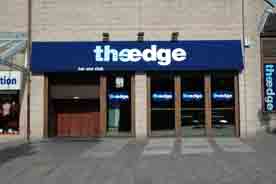
The Edge. 2006.
Unit 25 The Quadrant Centre, Coatbridge. ML5 3EG. Tel: 01236 440788.
The Edge. 2006.
18 Whifflet Street, Coatbridge. ML5 4EL. Tel: 01236 427947.
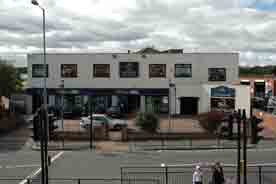
The Craigdhu. 2006.
59 Townhead Street, Hamilton.
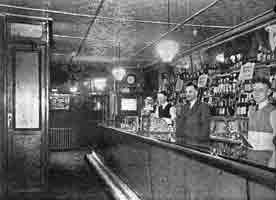
Interior view of the Argyll & Sutherland Bar. 1947. Mr Skelton the proprietor is on the centre of the image.
At a recent Licensing Court in Glasgow in 1947, reference was made by the Senior Magistrate to the necessity, in the interests of public hygiene, of the proper cleansing of glasses. The same subject had been discussed in the Lancet where the possibility of restaurants and public houses, in particular, becoming agencies for the spreading of infection is mentioned. It is obvious, of course, that rinsing in water already saturated with germs from previous washings is not wholly satisfactory, nor can a static water tank be compared, for cleansing purposes, with a constant supply of fresh running water.
In this connection a machine which washes glasses hygienically was shown at the Brewers Exhibition in London, but a similar idea was developed and perfected some time ago by a Glasgow Man, his invention being patented both at home and abroad. One of these machines is now in daily use in the Argyll & Sutherland Bar, Hamilton, where the proprietor, Mr Adam Skelton, who has been 21 years in the Trade, spoke highly in its praise.
“The Machine,” said Mr Skelton, is electrically driven and costs approximately one shilling per week for current. It can wash sixteen glasses every minute, equal to 960 glasses per hour. There is no waste of water as the flow ceases automatically when the glass is washed. Put on another glass and the water pressure commences again. Any size of glass or mug can be washed and thoroughly at that, both inside and out, and the customers see it done, which is a great point in its favour. The machine was an attractive addition to the furnishing of the bar; it was easily fitted, was compact and takes up little room. It was electrically driven by a small motor and a touch on the switch sets it going at once. I am so satisfied with the machine said Mr Skelton that I have ordered more for my other establishments.
Mr Skelton acquired the Brandon Bar, one of the largest public houses in Hamilton and he was in partnership with his brother James in two licensed pubs in Wishaw.
The Argyll & Sutherland Bar was a popular rendezvous, given its name by a former owner, who was a time served soldier with the Argyll’s. Photographs and murals depicting the regiment at home and abroad decorated the premises and additional decorative panels were shortly added. The establishment has been modernised by Mr Skelton and interesting features were a heated hand-rail surrounding the bar counter and the fire resistant coloured asbestos with which the walls were lined, a disaster later found out.
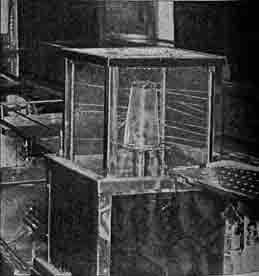
Glass Cleaner.
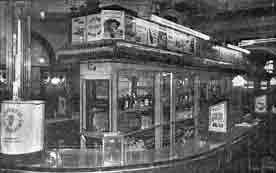
Interior view of the Brandon Bar, Hamilton. 1953.
Customers of Mr Adam Skelton who enter the Brandon Bar, Hamilton, are intrigued to see a mobile advertising display strip circulating round the top of the gantry.
The display contained 48 panels, each 14 inches wide and 17 inches deep, giving 48 advertisers the opportunity of calling the attention of customers to their products. Operated by a fractional horse power motor through a reduction gear box at a power cost of two shillings per week, the display works on an endless conveyor chain system, the panel holders being fixed to a chain and having a glass in then behind which a different advertisement can be placed as desired. An ingenious device permits of the panels taking the corners without trouble.
The display was the only one of kind in Britain. It was devised by Mr Skelton himself and the practical details of operation and manufacture were carried out by Mr R McKinlay Smith, 20 Springfield Court, Glasgow, who has taken out a provisional patent in connection with the apparatus.
The Photograph shows a section of the display, which is 56 feet in length and completes its full circuit in eight minutes.
In the NEWS 1977
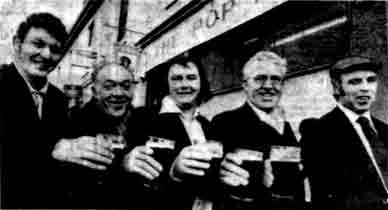
Five raising their pint glasses to The Pop Inn. They like it as it is. Left to right John McDade, David Gorman, Joseph Doyle, Bernard McMahon and Pat Duffy. 1977.
Hangover for pubs after big crackdown.
Do Airdrie and Coatbridge have the worst pubs in Scotland?
The double edged question is being asked by thousands of drinkers in the twin Lanarkshire towns after the licensing towns after the licensing court revoked two licences and gave more than two dozen pubs until April 15 to bring their plkaces up to standard.
John Hendrey, of West Kirk Street, Airdrie, said, “Airdrie is not bad for pubs. They’ve modernised a lot here. “But over in Coatbridge there are dozens of pubs that are dirty and old. Go down the Bank Street area. That’s where they are.”
REGULARS
His view was backed strongly by the licensing court, who names six Bank Street pubs among those who have to raise their standards to get their licence on April 15.
One of them was the Pop Inn at 261 Bank Street. But the regulars there were proud of their little bar. Bernard McMahon and his four drinking mated (David Gorman, John McDade, Joseph Doyle, and Pat Duffy) had popped in to the Pop Inn for a totle of 86 years.
Bernard said, “It’s a homely place. A working man’s pub. You don’t have to watch your language.
DISGRACE
At Tuesday’s licensing court the bench talked pubs that “were like speak-easies. Places that would have been in disgrace in the days of prohibition.”
The Bank Street pubs which must up their standards are, The West End hotel, The carlina, The Eagle, and the Pop Inn.
The proprietor of the West End Hotel said that there seemed to be a drastic crack down.
94 Whifflet Street, Coatbridge. ML5 4EJ. Tel: 01236 607126.
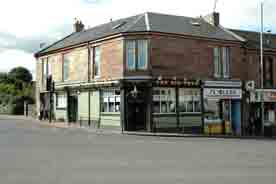
The Big Tree.
One of the proprietors in the 1920s was Patrick O’Brien he also owned the Killiekrankie Bar, 34 Locks Street, Coatdyke, Coatbridge, the Circle Bar, Main Street Coatbridge and the Auld Hoose, Gallowgate, Glasgow.
54 Main Street, Glenboig, Coatbridge. Ml5 2QT. Tel: 01236 870450.
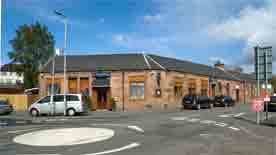
The Big Shop. 2009.