• Skip to primary navigation
  • Skip to main content
  • Skip to primary sidebar
Old Glasgow Pubs

Old Glasgow Pubs

  • Home
  • About Us
  • Find A Pub
  • Find Address
  • Find A Publican
  • Further Reading
  • Shop
  • Contact Us
  • Members Area
  •  
  • Click Here to Search the Site
You are here: Home / Archives for John Gorevan

John Gorevan

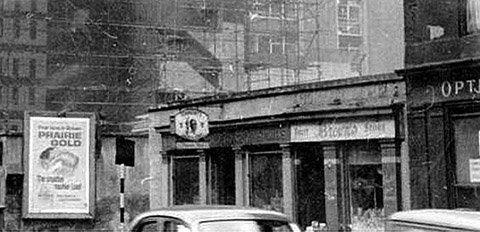
The Marquis

March 6, 2017 by John Gorevan Leave a Comment

21 Waterloo Street, Glasgow.
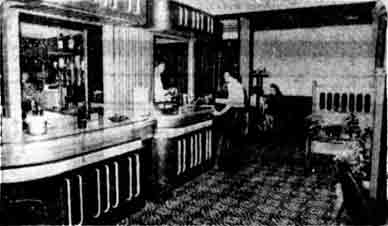
Marquis interior 1978

The Marquis, Interior of the lounge 1978.

In the NEWS 1978…

A Feast in Luxury from the Marquis…

It’s always refreshing to find a new restaurant that offers delicious food, at reasonable prices and served in pleasant surroundings.

But that just about sums up the Marquis, a new restaurant and cocktail bar which has just opened in Glasgow’s Waterloo Street.

The Marquis is owned by Mr Harry Nicholas, who has also owned Paisley’s Glynhill Hotel for the past eight years.

Following his success at the Glynhill, Mr Nicholas decided it was time to expand into Glasgow.

The Marquis is designed especially for people who appreciate good food and who want to dine in a relaxed atmosphere. Mr Nicholas has spared no expense in the decoration. Everything from the pure wool on the booth seats to the mahogany ceilings and partitions exudes quality. Only the best of materials has been used.

Undoubtedly the main feature is the actual bar in the cocktail lounge. It has been custom made in teak by Mr Tony Capriotti and is a beautiful piece of work.
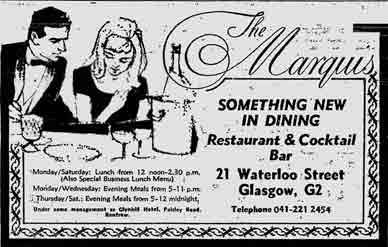
The Marquis advert 1978

FUNCTIONS

The Marquis has been designed on two levels. The lower level has the cocktail bar and part of the restaurant, while the upper level has a smaller restaurant, ideal for holding small functions.

In fact, although the Marquis has been open for only two weeks there have been two functions held already. The most important point about any restaurant is the food. And the Marquis comes up trumps.

The restaurant has an extensive menu which includes everything from steaks to moussaka. For the younger set, perhaps looking for a quick meal before going to the cinema, there are American-style char-cooked chopped beefburgers served with a relish tray and French Fries.

If you prefer a more substantial meal which you can linger over you can take your choice from a selection of steaks, including T-bone and porterhouse.

But if your eating tastes are a little adventurous then the Marquis can offer you a choice of continental dishes, many of them Greek. How does Dolmades sound for starters? That’s chopped meats with rice and herbs rolled and cooked in vine leaves.

You can follow that with Kleftiko lamb roasted in its own juices and herbs. It is served with roast or boiled potatoes and individual mixed salad. The Marquis also has a selection of Yugoslavian, Italian, German, and French wines.

One good point about the menu is that it contains no hidden extras. potatoes and vegetables are included in the price of the main meal. In charge of the Marquis is Mrs Margaret MacCallum, who has been in management at the Glynhill Hotel for eight years.
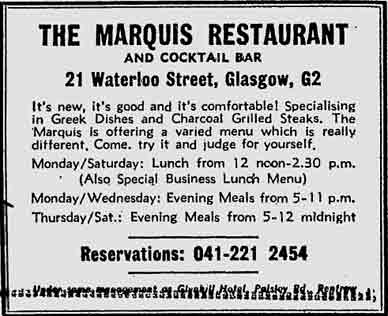
Marquis advert 1978

She has a staff of around 20 including two chefs and is delighted with the way the new restaurant has turned out. “It really is in the ideal position,” she pointed out. “We are only about two hundred yards from Central Station and only a few minutes from Anderston Bus Station.

So we are very handy for people arriving in the city and who are perhaps looking for a quiet meal after a long journey.”

The Marquis is open from 12-2.20 from Monday to Saturday, from 5-11 p.m. Monday to Wednesday, and 5-12 p.m. from Thursday to Saturday.

They offer a businessman’s lunch from Monday to Friday.

—————————————————
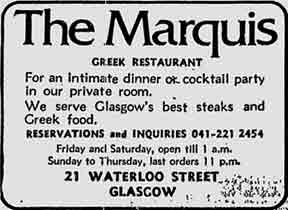
Marquis Waterloo Street advert 1979

The Marquis advert 1979.

Filed Under: M, Waterloo Street, WaterlooStreet

The Marland Bar

March 6, 2017 by John Gorevan Leave a Comment


54 George Street, Glasgow.

Marland Bar George Street

The Marland Bar, George Street. 1959.

The Marland Bar was once one of the haunts for the folk singers in Glasgow that loved to sing in Glasgow pubs, but singing was band in those days.

There’s been a pub on this site since 1830.

This is from a great book called Cod Liver Oil and The Orange Juice, reminiscences of a fat folk singer, Hamish Imlach and Ewan McVicar…

Page 54-55…

There were lots of all-night parties, and SNP dos to go to. People drank in the Eagle Inn or the Dunrobin. Singing in pubs was illegal at the time, and eventually the Marland Bar became the undisputed place to drink in, because they’s allow illicit singing with the drinking.

One Saturday we were thrown out of the Queen’s Own pub, off George Square, for persistent singing. Usually we’d go into the Dunrobin, and mumble the words of the songs in one of the booths. This time we went along George Street, found the next pub along was crowded- it being nine o’clock on a Saturday night- and went into the following one, the Marland Bar. There was a back room, which we all crowded into, and managed to order a couple of rounds before nine-thirty closing time.

The only other people in the back room were an old gent and his wife and daughter. He was a wonderful Donegal singer called Paddy Tourish. I didn’t know him then, but I could see from the murals on the walls it was a Donegal pub- murals which had been done by a guy who had been paid in drink, and it showed. On a sloping counter lay a half crown which was in fact bolted from the bottom, put there to entice strangers into putting a hat over it and trying to scrape it oiff the bar.

I thought “What the hell”, and sang Boolavogue.

At Boolavogue, as the sun was setting

O’er the bright Mary meadows of Shemalier

A rebel band set the beather blazing

And brought the neighbours from far and near

And father Murphy, from old Kilcormack

Spurred up the rocks, with a warning cry

“To arms’, he cried, ‘For I come to lead you

For Ireland’s freedom we’ll fight or die”.

Far from throwing us out the owner, Christie McMenanin, came into the back room with a whisky for each of us. We’d found our place.

A week later, we were lashing into all the Rambling Boy songs, and the Tourish family were there again. Rosie the daughter, said ‘Ma da’s a great singer’. He protested ‘Oh, no, no, I only know old fashioned songs, I enjoy hearing you young lads singing, it’s great. To read more of this great book please buy it.

Filed Under: George Street, GeorgeStreet, M

Madness Theatre of Fun

March 6, 2017 by John Gorevan Leave a Comment

Madness sign

30 Bothwell Street, Glasgow. G2 7EN. Tel: 0141 204 5999.


Madness Fun Bar Bothwell Street Glasgow

Madness Theatre of Fun. 2008.

Filed Under: Bothwell Street, BothwellStreet, M

J Monteith’s Bar

March 6, 2017 by John Gorevan Leave a Comment

387 Argyle Street, Glasgow.

J Monteith’s bar was a household name away back in the early 1800s. Good quality whisky and ale made this one of the best pubs in the city. An old gentleman Mr D MacKail worked all his days in the Argyle Street premises and carried on well into his retirement.

In 1875 Archibald McPherson purchased the business and property but never lived long enough to see his empire of public house thrive. Mr McPherson was a keen angler, on 17th July 1878 he drowned while fishing opposite Dunoon. His wife Margaret took over the business, she was left with six young children to bring up, the eldest was only 11 years of age. However she was helped by her mother and sister to look after the children and lived with her in Douglas Street. When her oldest son Hugh was of age he assisted in the running of the public houses.

There was at that time eight pubs in the McPherson family business including 200 Duke Street and 263 Duke Street, 460 Paisley Road, 389 Gallowgate, 224 Castle Street, 278 Main Street, Bridgeton, 8 Dale Street, Bridgeton and 387 Argyle Street. The old name of J Monteith’s stayed above the doors of the pubs, there was no half’s at the bar, no brandies and soda.

The Argyle Street business was more like a bonding store, every inch of the ground floor was taken up with puncheons, butts, and barrels of all ages, from the most select distilleries. The underground cellars were choke full with wines in the wood and bottles, from the choicest vineyards. La Rosa, 40 year old; Burgundies of 1863 and 1867; stacks of hocks of 1857 and 1868; ports of 1870; sherries of 1862; and scores of others in bottles, some of them 50 years old. A large stock of whisky was also stocked for vatting, prominent among those being “Orkney,” of 1882; “Royal Brackla” and “Long John” of the same date. Old brandies and Vieux Rhum there was an immense quantity lying in the cellars as well as outside bonding stores.

In charge of the bottling store was a Highlander Donald McDonald, the cashier was Mr Alexander McDonald, both were brothers of Mrs McPherson. McPherson’s had a large trade in liquor much heavier than that of Monteith’s. All of their pubs get there stock from these stores including ginger beer. The Argyle Street business stopped serving drinks at the bar and was entirely converted into a wholesale and family business.

To read more on the pubs on the Gallowgate read up & Doon the Gallowgate by John Gorevan. A copy can be bought for a few pounds at the Hielan Jessie on the Gallowgate or contact me at [email protected]

Filed Under: Argyle Street, ArgyleStreet, J

McPherson, Andrew

March 6, 2017 by John Gorevan 1 Comment


218 Crookston Street, Glasgow, and The Royal George Hotel, Rothesay.

Mr Andrew McPherson

Mr Andrew MacPherson. 1888.

Andrew MacPherson a native of Kilbirnie, his grandfather coming from Badenoch settled there in the early 1800s. In 1857 Andrew and his father Charles took over a pub at 218 Crookston Street, the street then had seven pubs and a licensed grocers shop. There was nothing out of the ordinary to be seen in the Crookston Street pub except perhaps a whisky barrel showing all the signs of old age. It lies straight across the counter and contained the genuine and pure Islay whisky from Ramsay’s distillery. Andrew stocked some of the best liquors in the area, his favourite being Long John’s Dew of Ben Nevis. They also stocked high class ports, sherries, Moet & Chandon’s champagne, Moselles, Hock and clarets, rums, brandies and gins, Reid’s, Bass and Allsopp’s beers.

In 1888 Andrew took over the Royal George Hotel in Millport, Millport then was as popular as it is today. For recreation purposes Mr MacPherson had two bowling greens on the grounds of the hotel, a golf course was near by, annual subscription 10s 6d, monthly 5s, weekly 2s 6d, daily 1s the ladies annual subscription was 2s 6d. One could get a coach ride around the island for one shilling. A weekly charge at the hotel with meals would set you back £2.2 shillings, from Saturday to Monday a charge of 15 shillings would secure you a good room and a slap up meal.

The Royal George Hotel in Millport had magnificent views, Eastwards, the Ayrshire coast, Westwards the mighty hills of Arran and Southwards the open sea. Roads were opened up to take you right round the Island, a bus ride of ten miles cost one shilling.

Crookston Street had a name change, in the 1930s it was called Carnoustie Street.

License Holders.

1857 Charles MacPherson.

1880 Andrew MacPherson.

1899 Andrew MacPherson.

1911 James K A Wilkie.

1920 James K A Wilkie.

1937 Hugh McLaren.

1960 Charles Clark.

Filed Under: Publican M Tagged With: Andrew McPherson, Crookston Street, publican, Royal George Hotel

McPherson, Archibald

March 6, 2017 by John Gorevan Leave a Comment


213 Bernard Street, Bridgeton, Glasgow.

Archibald McPherson ran this old pub in 1887, which sat at the corner of 41 Boden Street, Bridgeton, Glasgow. In 1889 wine and spirit merchant Robert A Burnside took over the property and turned it into a very popular bar. Robert’s father Matthew was a well known wine & spirit Merchant in the east end of the city, he had pubs at 18 London Street now London Road, and two pubs on Dalmarnock Road no 174 and 317 and one on Baltic Street no 323 and another on London Road at no. 463.

When his father died Robert took control of the London Street premises and his father’s pub at 174 Dalmarnock Road along with his own pub at Bernard Street. His brother Samuel took over the Plaza Bar at 317 Dalmarnock Road and the pub on Baltic Street.

During the First World War Bernard Street premises was run by Isabella Dunn, she was the wife of Robert Burnside who was remarried.

Filed Under: Publican M

  • « Go to Previous Page
  • Page 1
  • Interim pages omitted …
  • Page 289
  • Page 290
  • Page 291
  • Page 292
  • Page 293
  • Interim pages omitted …
  • Page 437
  • Go to Next Page »

Primary Sidebar

Become a Member of Old Glasgow Pubs

We are very excited to announce that we have created a new membership! In return for supporting the site, you will gain fantastic perks! Click below to find out how you can support the site!

💖 Donate via PayPal

All content on this site is Copyright Old Glasgow Pubs (OGP). To use any history or images, please make sure you link back to our site.

This website uses cookies to improve your experience. We'll assume you're ok with this, but you can opt-out if you wish. Cookie settingsACCEPT
Privacy & Cookies Policy

Privacy Overview

This website uses cookies to improve your experience while you navigate through the website. Out of these cookies, the cookies that are categorized as necessary are stored on your browser as they are essential for the working of basic functionalities of the website. We also use third-party cookies that help us analyze and understand how you use this website. These cookies will be stored in your browser only with your consent. You also have the option to opt-out of these cookies. But opting out of some of these cookies may have an effect on your browsing experience.
Necessary
Always Enabled
Necessary cookies are absolutely essential for the website to function properly. This category only includes cookies that ensures basic functionalities and security features of the website. These cookies do not store any personal information.
Non-necessary
Any cookies that may not be particularly necessary for the website to function and is used specifically to collect user personal data via analytics, ads, other embedded contents are termed as non-necessary cookies. It is mandatory to procure user consent prior to running these cookies on your website.
SAVE & ACCEPT