• Skip to primary navigation
  • Skip to main content
  • Skip to primary sidebar
Old Glasgow Pubs

Old Glasgow Pubs

  • Home
  • About Us
  • Find A Pub
  • Find Address
  • Find A Publican
  • Further Reading
  • Shop
  • Contact Us
  • Members Area
  •  
  • Click Here to Search the Site
You are here: Home / Archives for Address G / Gallowgateroad

Gallowgateroad

The Wee Man’s

March 27, 2017 by John Gorevan 1 Comment

361 Gallowgate, Glasgow.

The Wee Man's

The Wee Man’s.1991.

Also see the new Weemans at number 425 Gallowgate originally Mac’s Bar.

There has been a pub on this site since the early 1800s.

In 1891 John McConnell completely overhauled the old pub making major alterations to the interior. The bar counter was close to 40 feet in length extending from one end of the bar to the other. The old family department was also modernized. Before Mr McConnell took over the pub he was manager of Flynn’s bar in the east end of the city, he was also an expert blender of whisky.

Mr McConnell was born in Ayrshire in a small town called Sorn, Catrine, at an early age he came to Glasgow and worked in some of the best bars in the city. Mr Connell only lasted a few years in this pub on the Gallowgate and sold it on to Patrick Cassidy in 1894. A few years later Mr Cassidy took over a small pub in Camden Street, Gorbals. He ran the Gallowgate pub until 1921, he gave up the licence to concentrate of his other premises on London Road.

The licence was then taken over by Dominick J Muldoon, Dominick had experience in the licensed trade as he ran a pub in Gairbraid Street, Maryhill beforehand. He also owned pubs in Crookston Street, Stobcross Street and Gallowgate near to the corner of Fielden Street. The pub was known by the title of Muldoon’s. Dominick was refused the licence at Crookston Street for permitting a man to consume liquor on the premises after 9pm and fined 4 Guineas. Daniel Muldoon took over the licence after his fathers death in 1931. The pub was still in the Muldoon family in the early 1940s.

In 1947 the name of the pub was changed to the Wee Man’s, by the new landlord John Young. Mr Young served the locals in the Wee Man’s for 30 years.
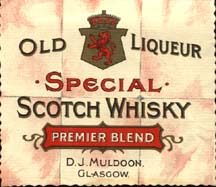
Whisky Label Muldoon's

D J Muldoon’s Special Old Liqueur, a whisky label found by an old friend of mine Wully Gallacher, in the Wee Man’s in the 1980s.

Mr Joseph Rock took over the Wee Man’s which was on a short lease as the Glasgow District Council had plans for the surrounding ground that the pub sat on which included the sit of the Rob Roy bar which was already closed down. The two pubs were finally demolished a few years ago, the land is still lying derelict. It was such a shame to see two of the Gallowgate’s best known pubs pulled down.

Mr Joe Rock changed the name of the Auld Hoose (Mac’s Bar,) to the Wee Man’s a pub which sits further along the Gallowgate near to the corner of Graham Square.
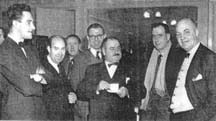
John Young

Members of the Licensed Trade Defence Association 1959. left to right C McCabe, Shakespeare Bar, Norman MacLeod, Townhead Cross Bar, Donald A MacLean, Coronation Bar, Edward Barrett, Halfway Bar, Rutherglen, Joseph McCabe, Kick Off Bar, J R Steedman, Burns Bar and John Young, Wee Man’s.
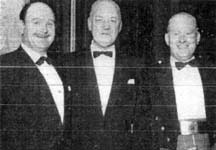
John Young2

Left to Right D D Rennie, Booths Gin, John Young and John E Jackson. 1962.
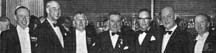
John Young1

Left to right at the Glasgow and District Licensed Trade Association, Thomas F Flynn, R W Nimmo, A Stewart, George Grier, R B Paxton, John Young, Donald MacLean. 1960.

To read more on the pubs on the Gallowgate read up & Doon the Gallowgate by John Gorevan. A copy can be bought for a few pounds at the Hielan Jessie on the Gallowgate or contact me at [email protected]
Licence Holders.
1999 Joseph Rock.
1991 Daniel Gray.
1973-1947 John Hunter Young.
1937-1921 Daniel J Muldoon.
1921 Dominick J Muldoon.
1914-1894 Patrick Cassidy.
1891 John McConnell.
1863 William McLaren.
1858 Archibald Weir.
1825 Alexander Blackie.

Filed Under: Gallowgate, Gallowgateroad, W

The Victory Bar

March 26, 2017 by John Gorevan Leave a Comment

675-679 Gallowgate, Glasgow.

The Victory Bar

The Victory Bar. 1970’s.

The old Victory Bar on the right hand side of the photograph was founded in 1861 by William McNicol. In 1873 John McNicol took over the running of the business, he had another pub on the Gallowgate at number 539, many will still remember this old pub as the Crest Bar also known as the Grant Arms.

John McNicol sold the Victory Bar in 1921 as he was now retiring at the age of 70 years, the pub was taken over by Peter McGonigle, he also ran the Regal Bar, Gallowgate now the Hielan Jessie, Peter died a few months after taking over the Victory Bar. As a result of his death his wife Mary had to run the two pubs and look after her young family of five children, the eldest was 14 and the youngest was only 1 year old.

Mary found it to very hard to run the two pubs, probably as a result of dishonest staff and trying to look after her young family, she sold the business in 1923 to John Mohan for a massive £950.00. John ran a successful business for the next 20 years.

After the Second World War the pub was run by Alexander M Fleck until the 1960’s, the last publican to run the Victory before it was finally demolished due to the redevelopment in the Gallowgate in 197’0 was Mr M Allan.

Filed Under: Gallowgate, Gallowgateroad, V Tagged With: Victory Bar

Tappit Hen

March 22, 2017 by John Gorevan 1 Comment

443 Gallowgate, Glasgow.

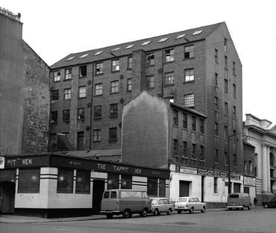
Tappit Hen

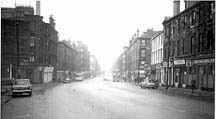
The Tappit Hen was one of 86 pubs from Glasgow Cross to Parkhead Cross.

There was a pub on this site since the 1830s, however it was better known by the locals as Brechin’s who took over the licence in 1881. The Brechin family ran pubs all over the city including New City Road, Aikenhead Road, Candleriggs, Florence Street, Govan Street, South Wellington Street, Hospital Street, Garngad, St Vincent Street, Donnelly Street, Abington Street and Bellgrove Street.

The Tappit Hen sat on the corner of Gallowgate and Graham Square.

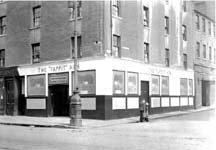
The Tappit Hen 1960s

The Tappit Hen. 1960s.

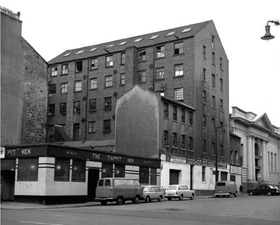
The Tappit Hen 1960s

The Tappit Hen getting a delivery of beer. 1960s.

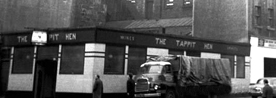
The Tappit Hen 1960s

Another view of the Tappit Hen during the 1960s.

To read more on the Brechin family click here.

To read more on the pubs on the Gallowgate read up & Doon the Gallowgate by John Gorevan. A copy can be bought for a few pounds at the Hielan Jessie on the Gallowgate or contact me at [email protected]
In the News 1972…

Old Pub is Frozen

The “Tappit Hen” is a well-known pub name in Scotland because it means a quart measure (usually containing alcohol) with a little, crest on the top like a hen’s.

But I’ve just discovered a Tappit Hen in Glasgow which belies its name. It’s in Graham Square, that entrance to the Meat Market just off the Gallowgate.

Its proximity to the Meat Market is appropriate for this Tappit Hen is a frozen-meat “cash- and-carry” headquarters. It must be the queerest cash-and-carry emporium in the city, because the main part used to be the Tappit Hen pub, hence the name. Where drouthy cronies gathered at the bar, carcases of bullocks and lamb hang now. And the place where the experts played darts is a deep freeze.

I was shown round by Bob Edwards, who is not only the owner but one of the Gallowgate “characters.” I’d hardly get over the shock of seeing a pub turned into a deep freeze when Bob took me round the corner into the Gallowgate to show me his extension. It used to be a branch of the Clydesdale Bank, and the first thing you see when you go in is a door with the legend “Manager.”

Every new and then Mr Edwards runs a competition for the best poem in the style of McGonagall about the Tappit Hen “And I’ve had some marvellous results,” he says.

“We’re not a very big place,” he added, “so we often have a queue outside the door. Well I went along to the Barrows and bought up some umbrellas at a bob a time. Now if there’s a queue standing in the rain, I go out and lend them each am umbrella.” They must have the best sheltered queues in Scotland outside the Tappit Hen.

Licence Holders.
1972 D G Hutchison
1960-1937 Charles Martin.
1928 James Anderson.
1921 James Pryde trustee for the Brechin family.
1916-1881 William Smith Brechin.
1863-1842 John Orr.
1838 William France.

Filed Under: Gallowgate, Gallowgateroad, T

The Saracen Head

March 22, 2017 by John Gorevan Leave a Comment

209 Gallowgate, Calton, Glasgow. Tel: 01415520370.

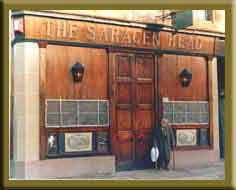
Saracen Head

The Saracen Head. 1991.

To read the full history of this historic landmark click here.

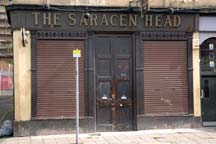
Saracen Head 2005

The Saracen Head, August 2005.

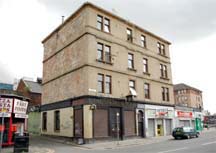
Saracen Head 20035

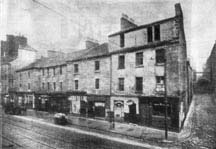
Saracen Head inn old

Other view’s of the old Saracen Head Inn, this one was taken just before it was demolished, the right hand side of this photograph at the corner of Saracen Lane is a public house, owned by Mrs McPhail.

In October 1773 Dr Samuel Johnstone and Mr James Boswell returned to Glasgow from their tour of the Hebrides. They put up at the Saracen Head Inn, Gallowgate and this is what Boswell wrote; ” On our arrival accounts from home, and Dr Johnston, who had not received a single letter since we left Aberdeen, found here a great many, the perusal of which entertained him much. He enjoyed in imagination the comforts which we could now command, and seemed to be in high glee. I remember he put a leg up on each side of the grate, and said, which a mock solemnity, by way of soliloquy, but bud enough for one to hear it; there am I, an Englishman, sitting by a coal fire. On Friday, October 29, the professors of the University being informed of our arrival, Dr Stevenson, Dr Reid and Mr Anderson breakfasted with us. Mr Anderson accompanied us while Dr Johnston viewed this beautiful City.”

Professor Reid and Anderson and the two messieurs Foulic, “the Elzevirs of Glasgow,” dined and drank tea with us at our inn. Boswell and Johnston left the Saracen Head Inn the following day and went to Ayrshire. There is a story that Dr Johnston and Adam Smith has a night’s drink at the Saracen Head Inn and their discussion ended in a swearing match. The very bowl they drank their punch at the Saracen Head inn was produced at a meeting of the Old Glasgow Club in October 1904.

Robert Burns and John Wesley, two rather different types took rooms there. In the summer of 1803. William Wordsworth and his sister Dorothy arrived, along with Samuel Coleridge. They stayed for two days and admired Glasgow greatly. The hackney coach in which they arrived was the first ever seen in the city and when they left to travel west-wards a crowd of small boys followed the coach cheering and shouting, for several miles.

Saracen Head inn old1

Another view of the old Saracen Head Inn, part’s of the old inn have now been converted into shop’s.

On 24th November 1754, therefore they sold the land of the Kirkyard of little Saint Mungo on the north side of the Gallowgate to Robert Tennent the owner of the White Hart Inn with provisions that he should erect a first-class inn on the site according to an agreed plan.

The Glasgow Courant for October 1755, the proprietor Robert Tennent, was careful to stress the modern comforts of the 36 room Inn: The bed-chambers are all separate, none of them entering through another, and so contrived that there is no need to going out doors to get to them. The beds are all very good clean and free from bugs.

Robert Tennent took the oppertunity to acquaint all ladies and gentlemen that the desire of the magistrates of Glasgow. He had built a convercent and handsome new Inn, agreable to a plan given to him. The Inn containing 36 fire-rooms was now fit to recive lodgers. The bed chambers are all separate, none of them entering through another. The beds are all very good, clean and free from bugs.

When the Inn was finished in 1755 it had stables for 60 horses and offices at the rear of the premises. There was a pump well in the yard which was thought to be the well created for the use of the chapel of Little St Mungo, when it was founded in 1500. A central broad flight of steps led to the Inn’s main entrance hall.

Coach’s left the Saracen Head Inn at 9 in the morning for Edinburgh and at any other hour that the first 2 passengers might agree on and that for Ayr at 10 oclock forenoon.

The Inn became known as one of the most spacious and elegant in Scotland. Merchant’s daughters were sent for lessons in the culinary arts, each paying the head chef 5 shillings to see how the different dishes were prepared and served up. At one great country dinner the appearance of 15 or 16 elegant young cooks with white aprons placing the dishes on the dinner table made such an impression on the gentlemen present that the younger and more sprightly county gentlemen immediately set about joking and flirting with these handsome cooks, and were greatly more entertained by this sport than with their dinner, for some of them went down to the kitchen and assisted the young ladies to hand up the dishes.

Dougal Graham, the skellat Bellman of Glasgow, was often seen about the Saracen Head Inn. He was lame, a hunchback, and a poet. He wrote several chapbooks which had a great sale for those days. He was appointed bellman about 1770, after a competition in which dozens of bellmen took part. The magistrates apparently picked Dougal because of his unusual appearance, his peculiar way of ringing the bell and his fine loud voice. For his test he cried in Stentorian Tones:

“Caller herring at the Broomielaw, Three a penny, three a penny!” Then he added: “Indeed, my friends, But it’s a blowflim, For the herring’s no catch’s, And the boat’s no’ come.”

What Glasgow Magistrates could resist such wit?

One day in 1776 some officers newly returned from American War were looking out of one of the windows of the Saracen Head Inn, when the Hunchback bellman come along, one officer shouted rudely, “What’s that on your back, Dougal? Dougal Graham just looked up and replied: “it’s Bunker Hill. Do you care to much?”

Saracen Head postcard

An old postcard view of the Saracen Head Inn with the new Saracen Head building in the back ground.

When other good hotels were built in Glasgow and the city moved west, the Saracen Head Inn fell on evil days, latterly it was turned into tenements and became a very seedy building. Before it was demolished the Old Glasgow Club met in the Great Dovehill mission hall, which in its palmy days, had been the Assembly Room of the Saracen Head Inn. The club members were able to mark out the Fiddlers Bank; a jort of minstrels’ gallery, where the famous Neil Gow among others, had played. On display was the great punch-bowl of the Saracen Head made to hold five gallons. On the bottom of the bowl is a fancy description of Glasgow:

In 1791 William Miller of Slatefield purchased the Inn and converted it to shops and houses, he also built an addition to the east. For about 50 years the ball-room was used as a place of worship by various sects, after which it became a reading school.

Saracen Head interior

Interior view of the Saracen Head before alterations. 1990.

Saracen Head interior1

Interior of the Bar 1990.

Saracen Head Rabbie Burns poem

An old poem written by Rabbie Burns in 1795 guarded by bars and hard glass. It as now sadly disappeared from the bar, and is supposed to be in the owners safe hands.

In 1892 the Authorities had a family evicted in Saracen Lane, for their involvement in the making of an illegal still and using their house as a shebeen, after their house was raided, everyone was arrested, the outcome was heavy fines and their home had been condemned, the tenants were told to seek pastures new.

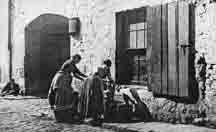
Women wash clothes outside of the Saracenhead Inn

These ladies were washing clothes outside the Saracen Head Inn, the archway in the background was the carriage entry to the Ballroom.

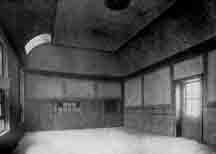
Assembly room

The old Ballroom, assembly room. 1900.

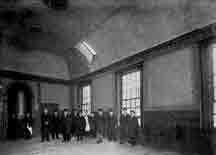
Assembly room

Another view of the Assembly room. 1900.

The old well at the rear was restored in 1906, a charming Iron Fountain which was made by the Saracen Foundry in Possilpark. There was another building at the back an Elizabethan type building, now demolished. It was put up by one of the Anderson’s of John Anderson’s Royal Polytechnic as a boy’s club. It served various functions, including for a time that of a film studio.

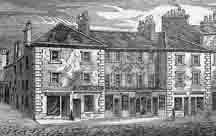
Etch of Saracen Head Inn

An old Etch of The Saracen Head Inn with shops on the ground floor.

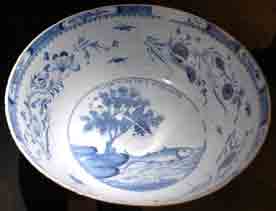
Saracen Head Punch bowl2

The Saracen Head punch bowl.

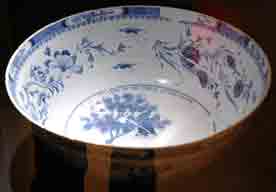
Saracen Head Punch Bowl2

This Punch bowl was made by the Delftfield Pottery Company in Glasgow in the 1760s. It was made for the Saracen Head Inn. Punch is a drink from mixing different alcoholic drinks and fruit juices.

The Delftfield Pottery Company was set up in 1748 near the Broomielaw on the River Clyde. Here the potters made tin-glazed earthenware known as delft-ware. Delft is a town in Holland where this type of pottery was first developed at the end of the 17th century. The Dutch potters got their ideas from China.

Much of the delft-ware made in Glasgow was sent to the American colonies to meet the demand of the settlers for good quality china. One of the first share-holders in the company was Robert Dinwiddie who later became Governor of Virginia where much of the pottery was sent.

The punch bowl had been broken and repaired may times perhaps during a heavy drinking session! Last century it was repaired using plaster, cement and metal rivets to hold it together. Its many rivets were corroding and causing damage to the bowl, they were recently removed. The bowl is now held together with a safe and completely reversible adhesive.

On the site of the Saracen Head Inn, and just outside the city Port, stood the chapel called Little Saint Mungo’s, surrounded by a burying ground. It was founded some time before 1500 by David Cunningham, archdeacon of Argyll. In a deed granted by him in that year, endowing the chapel, he describes it as “unam capel-” Lianam cum.

After the reformation it became the property of Donald Cunningham of Aikenbar and Marion Lyon, his wife, from whom it was purchased by the Magistrates in 1593 at the price of 200 merks- £13, 6s. 8d according to the value of Scots money at that time. On the condition that the “Chapell, hous, and yaird were to be maintained as an hospital for the poor. The Magistrates did convert it into an hospital for lepers, and for some time maintained it as such; but in breach of their trust, they converted it about the middle of 1700s to Robert Tennent for the purpose of his building on it a first-class hotel, which he did. This was the Saracen Head Inn.

Even so late as 1737, when McUre (Glasgow Historian) wrote his history, the Gallowgate extended no further than the East Port. Beyond that was only a narrow country road, chiefly between hedges, leading to the old village of Camlachie. Between that Port and Glasgow Cross, and not far from the old chapel, the street was crossed by the Molendinar Burn, like St Enoch’s Burn, it crossed on the surface, and there was a considerable decent to it on each side, with stepping stones in the stream for foot passengers. When it was swollen by rain, people had to cross in carts or on horse-back. The burn was a favourite place for watering horses and cattle, and Dr Buchanan, writing in 1856, says he had conversed with old people who remember it in that state. Now a foul underground sewer, it was then a clear limpid stream. In the Glasgow Courant for 1755 there is an advertisement of a piece of ground at the Spoutmouth to be let and one of the inducements held out to a tenent is its vicinity to the Molendinar as suitable for bleaching.

Besides the trees of St Kentigern in the foundation of Little St Mungo’s church, there was near the same place a well, called St Mungo’s well- fons Kentigerni.

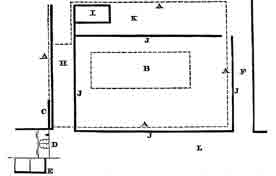
The Plan of Little St. Mungo’s Chapel was built in Octobert 1500. The chapel was erected just beyond the Gallowgate Port (or Gate) near “the trees of St. Kentigern,” a small wood. It was surrounded by a cemetery and there was a well in the grounds (referred to in 1558 as “Saint Mungo’s Spoutis”) that was reputed to contain water of a very high purity.

Saint Mungo's ground plan

Ground Plan of Little Saint Mungo’s Chapel.

Lands of Dovehill, partly covered of old with trees.

A.A.A.A. Dotted Lines. Supposed line of Church-Yard Dyke.

B. Little St Mungo’s Chapel, surrounded by Burying Ground.

C. A small piece of wall remaining in a close.

D. East Port, taken down by Provost Cochrane in 1749.

E. Old Houses. (No. 182 Gallowgate,) against which the south end of the port rested. The north end of the port joined the south end of the Kirk-Yard Dyke; and where Dovehill was opened the west part of the old dyke was allowed to remain until houses were built along its line.

F. Saracen’s Lane, or Brass Bell Lane. An ancient thoroughfare to the north,- supposed to be the Priests’ Road to the Cathedral; amplified when the Saracen’s Head Inn was built, as a private Entry to the Stables. This road went along the east side of the old Kirk-Yard Dyke.

H. Great Dovehill. The west side of the old Kirk-Yard. This was the carriage Entry to the Ball-Room, &c., marked.

I. Ball-Room of the Saracen’s Head Inn.

J.J.J.J. Indicate the area occupied by the Saracen’s Head Inn, built within the ancient Kirk-Yard, and partly on the site or the Chapel. The frontage to the road or Gallowgate was 100 feet.

K. Court Yard of the inn.

L. Gallowgate to Camlachie.

Like many of the old Saints, Kentigern is said to have had his bed, his bath and his chair. The bed, Jocelin tells us, was hollowed out of rock. He bathed in the Molendinar, and his seat, according to an ancient tradition, was “Super Lapidem in Supercilio Montis Vocabulo Gweleth.” Gweleth, forming in combination Wleth, signifies dew, and hence, it has been said, the hill was called Dew Hill, converted afterwards into the present name Dowhill or Dovehill.

The Gallowgate ended in a common called the Gallowmuir. The place of execution was there, and till near the end of the 1700s, the Gallows- which gave their names to the North West end of the Common, near the upper corner of what is now Barrack Street. Extended east from the Butts (afterwards the Barracks) to Camlachie, bounded on the north by the Carntyne Road, once a Roman “iter,” and on the south by what is now Calton. The muir was a wild common, overgrown with whins. Whitevale, Annfield, Bellfield, Slatefield, Campbellfield, Jeanfield, and other villas were built on Gallowmuir. Annfield was built by Tennent, who called it after his wife, Ann Park. The memory of Ann, Bell, Campbell, Jane and Slate-field are preserved still (1894) in the names of streets in the locality. Burgh Records, 21st May 1625-“Ordaines the Master of Work to repair the buttis in the Gallowmuir for exercis of schutting quha pleisses.”

The Gallowgate Port was taken down in 1749.

Email from Robert Douglas…

I wondered if in your researches you had come across any references to my grandfather Hamilton aka Joseph Douglas who was born in the East End of Glasgow. I attach my life line for him, emboldening those parts which are relevant to your research on shebeening and running illict stills.

never met my grandfather, and my late father, also a Joseph Douglas, never saw him again once he was taken into care, following the fourth imprisonment and lived with foster parents in Kiltarlity near Inverness. In the parish record relating to the fostering my grandfather was described as guilty of shebeening.

In the past few years I have managed to piece some material together, through visits to the National Archives and the Mitchell Library. It is possible however you know more than me! I have copies of the relevant Glasgow Herald and Evening Times articles, but not the Eastern Standard. Do you know where copies of this paper still exist?

Sadly, the only known photograph of my grandfather was in a wallet stolen from my dad when he worked in a London pub as a youth. He thereafter lived most of his life in Corby, which is where I was born and live. (Little Scotland!)

Although I have no evidence, my dad used to reckon that my grandfather got the idea of making a still as a result of being an orra man in the Saracen’s Head. Apparently, being a tin or coppersmith he was asked to repair “something” there. One wonders what the something was. About 20 years ago I took my dad on a sentimental walk along Gallowgate and the Dalmarnock Road and we met Wee Angus in the Saracen’s head, who reckoned as a wee boy he remembered a Douglas fixing things. So there may be substance in the story.

My grandfather’s spirit was distilled from the spent barley handed out apparently free to the poor by Tennents in Duke Street. It was his contention it was not completely spent and of course he was correct. My dad remembered ferrying the liquor on trams to distant points and calling at the back doors of bars where the Douglas spirit was purchased and apparently mixed with proper whisky by the landlords.

Witch’s Skull

There is also a rumour that the skull of a witch (some say Maggie Wall’s) is displayed in the pub. If superstition is up your street, you can read more about it here – https://talesofmythandmagic.co.uk/maggie-wall/

To read more on the pubs on the Gallowgate read up & Doon the Gallowgate by John Gorevan. A copy can be bought for a few pounds at the Hielan Jessie on the Gallowgate or contact me at [email protected]
Filed Under: Gallowgate, Gallowgateroad, S Tagged With: The Saracen Head

The Royal Bar

March 22, 2017 by John Gorevan 2 Comments

464 Gallowgate, Glasgow, corner of 1 Tureen Street.

The Royal Bar Gallowgate

The Royal Bar. 1970s.

The Royal Bar sat at the corner of 1 Tureen Street and 464 Gallowgate. Many will remember this pub as the Windmill Bar.

There has been a pub on this site since 1815 operated by John Thomson.

Michael McGonigle brother of James McGonigle owned the pub in the 1940s. Michael went on to own the Swan Inn in Lennoxtown in the 1950s.

The Swan Inn Lennoxtown

The Swan Inn, 1 Quarry Street, Lennoxtown.

The Swan Inn Lennoxtoun 1

Another image of the Swan Inn 1950s.

The Swan Inn is still opened today. 2010.

However, the old Royal Bar on the Gallowgate was demolished around 1976 in the massive clearance of the old Gallowgate tenements and pubs.

To read more on the pubs on the Gallowgate read up & Doon the Gallowgate by John Gorevan. A copy can be bought for a few pounds at the Hielan Jessie on the Gallowgate or contact me at [email protected]
Licence holders…

1972 Elsie Eadie Thow Angus.
1972 Alexander Young Ford.
1947 Michael McGonigle.
1937John Kellegher.
1928 John Kellegher.r
1914  Mary Boyle Gibbons Moen.
1902 Charles Colvin.
1888 Charles Colvin.
1863 Peter Robin.
1841 Peter Robin
1824 Rodger Mullen
1815 John Thomson.

Filed Under: Gallowgate, Gallowgateroad, R

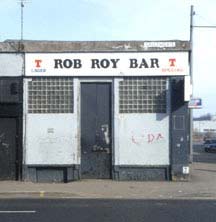
The Rob Roy

March 15, 2017 by John Gorevan Leave a Comment

389 Gallowgate, Glasgow.

Rob Roy

The Rob Roy. 1991.

This was one of my old favourite pubs in the east end of the city.

Situated at the corner of the Gallowgate and Hill Street, it was a popular haunt for employees of the meat market and Tennent Caledonian Breweries.

There has been a pub on this site since at least the 1830s. In 1863 Archibald MacPherson took over this old established howff, Mr MacPherson was a prosperous businessman also having pubs in 278 Main Street, Bridgeton, 2 pubs on Duke Street, one at 200 and the other at 263 Duke Street, 460 Paisley Road, 224 Castle Street, 8 Dale Street and the very old established “Monteith’s” tavern 387 Argyle Street.

Archibald took over “Monteith’s” tavern in 1875, however he was not to live long to enjoy his small empire of pubs or to watch his young family growing up, he drowned in the summer of 1878, while fishing opposite Dunoon. His wife Margaret carried on the business and when Hugh the eldest son was of age he helped his mother in the running of the family concern.

The old “Monteith’s” premises were converted into a store and bottling department for wholesale no drink at the bar was sold, every inch of ground floor was taken up with puncheons, butts and barrels. The underground cellars were also full of the very best wines in wood and bottle from the choicest vineyards. La Rosa 40 year old, Burgundies of 1863 and 1867, stacks of hocks of 1857 and 1868, ports of 1870, sherries of 1862 and scores of other bottles some of them over 50 years old. A large stock of whisky was also ready for vatting, prominent among them was “Orkney,” of 1882, “Royal Brackla” and “Long John,” old brandies and Vieux Rhum.

At the rear of the building a Highlander Donald McDonald, a brother of Mrs MacPherson was in charge of the bottling, another brother Alexander was cashier. It was somewhat a family affair at Monteith’s old premises.

In 1899 Robert Allan Stevenson took over the pub on the Gallowgate the name above the doorway was then Stevenson’s which stayed in the family until around 1930.

Gallowgate publican Archibald McIntyre then took over the pub, Archie had McIntyre’s Bar further alone the Gallowgate at no. 615 next to the Bellgrove Hotel, his father Dugald had it before him acquiring it in 1898. On the outbreak of the Second World War the Gallowgate pubs were run by Mrs McIntyre as all the young male members of the family were in the forces. Dugald McIntyre then took over the licence, however in 1945 young 21 year old Dugald was killed in action, he was in the Merchant Navy. The McIntyre family continued to run the pubs successfully until the 1950s, the Rob Roy however was sold to Colin H M McNab in 1960. Colin’s son John then took over the running of the pub running it until it closed in the 1990s. John was a real gentleman when I met him in the Rob Roy many years ago he always welcomed me when I was researching the Gallowgate pubs.

Rob Roy interior

Interior view of the Rob Roy circa 1960 with John McNab in the foreground.

One day not long before the pub closed, I gave John McNab a visit, we chatted about the various pubs on the Gallowgate when he stopped and looked over towards the small glass heated cabinet that held the hot pie’s, and said to the barmaid his wife, there’s the little bugger there, I looked round thinking he was talking about some child that came into the bar, John and his wife laughed, I still couldn’t see anyone, then John pointed him out to me, a small mouse eating crumbs on the bar, I jumped as I am still not very sure when rodents are around me.

John was great at telling stories and talked about the barber’s shop that used to be next door, the barber himself would frequently nip into the bar for a quick one in between customers. It was for this reason he became known to the locals as Sweeney Todd. One day he dived into an adjacent toilet and within seconds was screaming. “There’s a dead body on the toilet,” he told people who crowded round to investigate.

There was a body, as such, mischievous workers at the nearby meat market had skinned a sheep and deposited it on the WC for him to find.

Archibald McIntyre

Group of eastend publicans back row on the far right is Archibald McIntyre, owner of the Rob Roy, Gallowgate and McIntyre’s Bar also Gallowgate. 1934.

To read more on the pubs on the Gallowgate read up & Doon the Gallowgate by John Gorevan. A copy can be bought for a few pounds at the Hielan Jessie on the Gallowgate or contact me at [email protected]
Licence Holders.
1991-1970 John Hamilton McNab.
1960 Colin H M McNab.
1957 J Paterson.
1950 Mary McMillan McIntyre.
1944 Dugald McIntyre.
1937-1934 Archibald McIntyre.
1928 Ann McOnie Sutherland, Stevenson, Wilson.
1902-1899 Robert Allan Stevenson.
1885-1879 Mrs MacPherson.
1878-1863 Archibald MacPherson.
1860 Thomas Morrison.
1859 John McKinnon.
1831 William King.

Filed Under: Gallowgate, Gallowgateroad, R

  • « Go to Previous Page
  • Page 1
  • Page 2
  • Page 3
  • Page 4
  • Page 5
  • Interim pages omitted …
  • Page 9
  • Go to Next Page »

Primary Sidebar

Become a Member of Old Glasgow Pubs

We are very excited to announce that we have created a new membership! In return for supporting the site, you will gain fantastic perks! Click below to find out how you can support the site!

💖 Donate via PayPal

All content on this site is Copyright Old Glasgow Pubs (OGP). To use any history or images, please make sure you link back to our site.

This website uses cookies to improve your experience. We'll assume you're ok with this, but you can opt-out if you wish. Cookie settingsACCEPT
Privacy & Cookies Policy

Privacy Overview

This website uses cookies to improve your experience while you navigate through the website. Out of these cookies, the cookies that are categorized as necessary are stored on your browser as they are essential for the working of basic functionalities of the website. We also use third-party cookies that help us analyze and understand how you use this website. These cookies will be stored in your browser only with your consent. You also have the option to opt-out of these cookies. But opting out of some of these cookies may have an effect on your browsing experience.
Necessary
Always Enabled
Necessary cookies are absolutely essential for the website to function properly. This category only includes cookies that ensures basic functionalities and security features of the website. These cookies do not store any personal information.
Non-necessary
Any cookies that may not be particularly necessary for the website to function and is used specifically to collect user personal data via analytics, ads, other embedded contents are termed as non-necessary cookies. It is mandatory to procure user consent prior to running these cookies on your website.
SAVE & ACCEPT