23 Royal Exchange Square, Glasgow. G1 3AJ. Tel: 0141 225 5612.
One Up. 2008.
This is one of James Mortimer’s establishments. Next door to this is the Social and Rogano all owned by the same man.
23 Royal Exchange Square, Glasgow. G1 3AJ. Tel: 0141 225 5612.
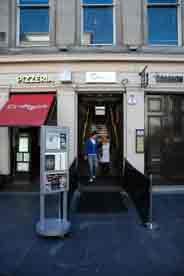
One Up. 2008.
This is one of James Mortimer’s establishments. Next door to this is the Social and Rogano all owned by the same man.
457-59 Govan Road, Glasgow.
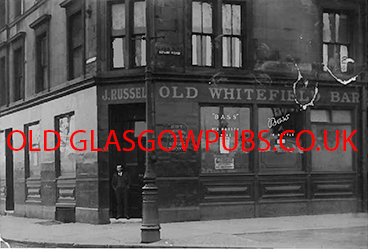
The Old Whitefield Bar, (Russell’s Bar).
There has been a pub on this site from the early 1870s.
The first owner of this popular Govan Road pub was Mr Francis Lochrane, who’s father was also a wine and spirit merchant trading at 9 Plantation Street. Francis resided at 2 Walmer Crescent in 1871 before moving to better accommodation 2 Cecil Place, Paisley Road.
In 1875 Francis Lochrane was a wine merchant and Strauraisse Quarry, (not known what this is), at 8 MacLean Street and lived at 2 Cecil Place, Paisley Road.
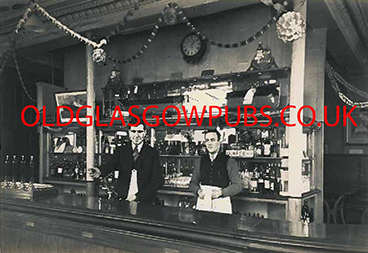
Interior View of the Old Whitefield Bar, with manager and head-Barman on the right.
In 1880, apart from being a wine merchant, Francis was a house proprietor and Land Factor at 6 MacLean Street.
Business was good and by 1890 Francis had already expanded his bussiness, having a licensed grocer office and store at 2-4 and 6 Eaglesham Street, a public house at Plantation Building, Govan Road, and Family Grocers at 105 Allison Street, and was now residing at 12 Campside Crescent, Langside.
After Mr Francis Lochrane’s death his wife Marie took over the running of the business. By 1919 Marie Lochrane was paying £120 per annum in rent for the Whitefield Bar also having pubs at 132-34 Blackburn Street, another pub at 71 Govan Road and 2-6 Eaglesham Street.
The Lochrane family gave up the trade in 1933. John Russell then became the new licensee. John’s wife Marie was also well-known in the licensed trade. In 1950 John’s wife Elizabeth Shaw Templeton Barclay Philip Russell was licensee, what a very long name. It is said that Mrs Russell ruled with an iron fist. All the gangsters of the day were shit scared of her!
The Russell family continued to serve the locals here until 1960. The last licensee was Patrick C Scouler.
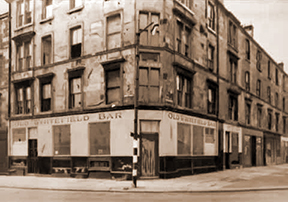
Derelict building with the Old Whitefield Bar, Govan Road at the corner of Whitefield Street.
36 North Frederick Street, Glasgow. G1 2BS.
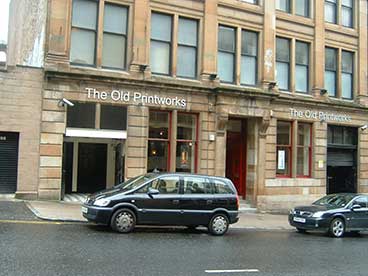
Now Closed down 2009.
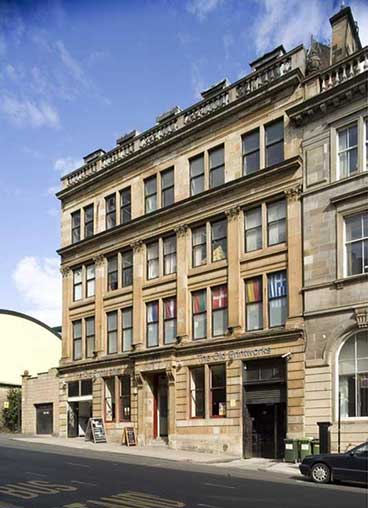
Update… The premises will be refurbished into Student Accommodation.
Thanks to Derek. email… Old Printworks
I remember this pub from college and a few works nights out. It had a kind
of raised walkway/catwalk from the door to the bar at the back. Also had an
upstairs with white brick/tiles.
Carmunnock.
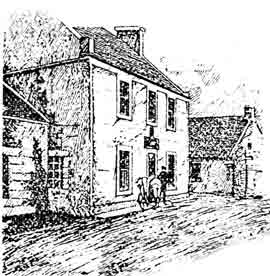
Old Inn, Carmunnock, 1894.
The Old Inn, Carmunnock, was a plain old fashioned inn, externally and internally. In the front wall of an adjoining out-house may be traced the date 1793, the inn itself was even older. It contained seven apartments, two of which , the sitting-room and the kitchen, were on the ground floor. The sitting-room, was small, neat and comfortable. A cheery fire burned in an old grate, with its knobs of shining teel; “Mrs Mew,” a favourite cat, sat demurely on the hearth, effected in nowise, it was evident, by the presence of a stranger.
The kitchen was very old, it looked as if nothing had been changed in it since the beginning of the 1800s. The wide fireplace, dish racks, cupboards, curtained, naked joists and stone floor, ornamented by this and the other design in chalk, all belong to the old-fashioned country inn of a three hundred years ago. Over the doorway, embellished by a representation of the rose, the thistle and the shamrock, each entwined within the other, the name is Orlando Young.
Mr Young, however was deceased. The business, which has been in the hands of the Young family for upwards of a half a century, was carried on by his widow, assisted by a daughter. Many years ago a social club met here at intervals, the members of which came all the way from the city. They were jovial gentlemen, it would seem. One a year they had a grand feast of herrings and potatoes, when songs were sung and stories told and bumpers drunk with a heartiness and hilarity that, so to speak, knew no bounds.
As to the village of which the inn formed a part, it was one of the very oldest and quietest. There was not a straight street in Carmunnock and hardly three houses in a line. The houses were heaped and muddled together in conspicuous confusion, a feature that was thoroughly English. The agree, or bit of common ground, was also a characteristic of the English village. If English in these respects, it was Scotch in every other, except, perhaps, the sign already referred to over the doorway of the inn, which was broad and liberal in its meaning, and not all in keeping with the exclusive spirit manifest throughout the village.
The Parish Church was of great antiquity. It was a curious little structure, with an outside stair leading up and into the gallery. The belfry was an open one, and had just received a new bell. Through the kindness of the sexton. In size and weight it did not exceed what a man may lift. It was made in Belgium, and bears the Latin inscription, Michael Burgeryus me fecit, 1618 (Michael Burgery made me, 1618.) In the vestry there was a little library, a portion of which was allotted to the use of the children attending the Sabbath School. The other presents a good instance of the exclusive spirit already noticed. The works were all, or nearly all, those of Scotchmen.
85-105 Main Street, Gorbals.
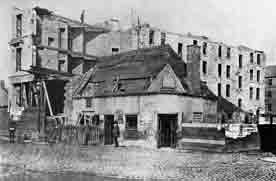
Old Gorbals Wine & Spirit Vaults. c 1870s.
The Old Gorbals Wine & Spirit Vaults was once part of the chapel which formed part of the 17th century mansion house of Sir George Elphinstone of Blythswood. The building was demolished under the City Council Improvement Trust around 1870s.
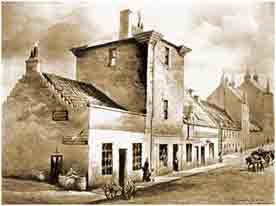
This venerable pile, so long identified with the Barony of Gorbals, was erected between the years 1600 and 1608, by Sir George Elphinstone, the son of a merchant in Glasgow, who had acquired the lands on the south side of the river known as “St. Ninian’s Croft,” from Boyd, the Protestant Archbishop of the See. With the view of forming a suitable residence, Sir George enclosed part of the croft for an orchard and garden, and built thereon the erections which so long formed the most prominent objects on the east side of the Main Street of Gorbals.
Tradition informs us that he also erected a small Chapel adjoining, part of which still exists at the corner of Main Street and Rutherglen Loan. It was in this baronet’s favour that the village of “Gorbals” was erected into a Burgh of Barony and Regality. Although this gentleman enjoyed great distinction in his lifetime, and rose to the rank of Lord Justice Clerk in the reign of Charles I., he afterwards became reduced in circumstances, and died miserably and in poverty about 1634. According to McUre, he was privately interred “in his own chapel, adjoining to his house.” The property was then sold by the creditors of the deceased to Robert Douglas, Viscount Belhaven. This nobleman extended the mansion in Gorbals, and built a square Tower or “Fortulice,” which is now almost the only part of the venerable buildings existing. Until within a few years ago, the Tower in question exhibited four turrets, which of course gave an imposing appearance to the structure. On the building adjoining the Tower may still be seen the family arms of Viscount Belhaven, pretty well cut in stone, the whole surmounted by the letters S. G. E., which are apparently meant for the initials of Sir George Elphinstone. It is not at all improbable that this was not the original position of the arms referred to, but that at some period when alterations were made on the Tower, they had been removed from it, and placed so as to face the Main Street of the Barony.
The Viscount, at his death, was succeeded by his nephew, Sir Robert Douglas of Blackerston, who sold the Gorbals Mansion House and lands in cumulo, some time prior to 1661, to the town of Glasgow, the Trades’ House, and the Trustees for Hutcheson’s’ Hospital. They were retained as a sort of co-partnery possession till 1790, when a division was made, and the central portion, containing the old buildings, fell to the lot of the city. The most important event connected with the Baronial Hall structure is found in the fact that at one time it formed the residence of Sir James Turner, Commander-in-Chief of the Forces in Scotland in the reign of Charles II., and who is understood to be the personage who supplied Sir Walter Scott with the portrait of Dugald Dalgetty.
The terms on which Sir James obtained possession of the house are somewhat singular; for it appears by the minutes that on the 18th July, 1670, the Bailie’s and Council “ordains ane tack to be wrytten and subscryvit in favors of Sir James Turnor, of the toune’s houss and tour in Gorballs, quhilk he presentlie possesses, and that dureing his lifetyme, for payment yearlie of three punds Scots, if the samyne be requyred.” Sir James accordingly died in possession of the subjects; and from the records kept in the College, it would appear that at the sale of his effects, a part of his scanty library was purchased by the University of Glasgow. Amongst his books were several works upon the art of war; but the soldier of fortune had not overlooked productions of a more elevating and humanising kind, for Milton’s “Paradise Lost” and various kindred tomes are found in his catalogue. Who were the successors of Sir James Turner, in the “toune’s houss and tour,” we have no way of knowing. At all events, as the locality was never an attractive one for the Glasgow merchants, the occupants must have gradually descended in the scale of quality. Before the close of the last century, and for some time afterwards, the principal room in the Tower, which was of a spacious kind, was used as a place of meeting by the magistrates, heritors and feuars of the parish of Gorbals; and here also the inhabitants mustered previous to performing the dutes of watching and warding, in days when a police force did not exist. Latterly, part of the old building was fitted up as a police-office, with adjoining cells. But it lost all its importance, excepting such as it retained from olden associations, when the official staff was removed to the present extensive police establishment in Portland Street.
It was then given over to very humble uses – the ground floors to the street being let as whisky shops, and the upper flats having been split up into dwelling-houses for the lowest class of the people. The greater part of the structure built by Sir George Elphinstone was taken down early in 1849 by order of the Dean of Guild Court, from its having exhibited symptoms of insecurity. It was then a fine remnant and wreck of the Scottish urban Manor House style, with its oriel windows, ornamental ceilings, and stout oaken staircases. The Tower, which remains, though sadly dilapidated externally and internally, still exhibits evidences of the aristocratic aspect it wore in the days of other years.
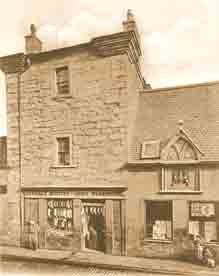
The Old Baronial Hall was built by Elphinstone in 1601. Following his death in 1634 the building passed down through several owners including Robert Douglas, Viscount Belhaven (who added a distinctive square tower), Gorbals Town Council and Sir James Turner. It was demolished in the early 1870s. Thank to the Mitchell Library.
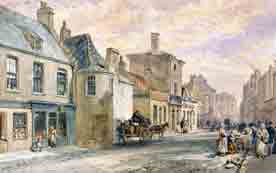
Main Street, Gorbals by William Simpson (1823-1899).
This watercolour provides a view of Main Street (later Gorbals Street) looking south. Sir George Elphinstone became MP for Glasgow in 1583 and Provost in 1605. He acquired land in the Gorbals in 1601 and built a mansion and chapel (left). He died in 1634 and his estate was sold to pay his debts. Robert Douglas, Vicount Belhaven, purchased the barony and added the square tower (middle distance) to the old baronial hall. Only the bases remain here, of the square turrets which once adorned each corner. The round tower in the street has also been reduced in height. By the 1840s the chapel had been converted into a pub, identifiable by the gilt board sign hanging outside. The Citizens’ Theatre now occupies the site of the house and church.
This watercolour is one of a series of fifty-five painted by Simpson between 1893 and 1898. Most are based on sketches he completed fifty years earlier and which appeared as black and white illustrations in Views and Notices of Glasgow in Former Times, published in 1848 by Allan & Ferguson.
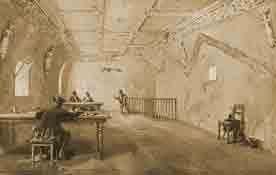
William Simpson’s impression of the interior of the old Gorbals Baronial Hall, as it appeared on 23 August 1858.
By the time Simpson visited in 1858 a part of the hall (with the neighbouring chapel) had been converted into a public house, the Old Gorbals Wine and Spirit Vaults. However, the ornate ceiling and cornicing and the statuettes on the walls are reminders of the building’s former glories, as the home of one of Glasgow’s most prominent men of affairs. The initials S G E and D A B on the ceiling were part of the original decoration and stood for Sir George Elphinstone and his wife Dame Agnes Boyd.
45 Adelphi Street, Glasgow.
The Old Burn Foot Vaults was one of Glasgow’s very old drinking dens. It stood at the well known corner of Crown Street and Adelphi Street in the Gorbals. In 1886 the old howff was taken over by Mr E Leslie, he succeeded Mr McQueen and had extended the property of the place in a wonderful degree. Apart from its old appearance relatively good quality liquor was stocked. Back in the old days when the cotton trade was in full swing, when poverty was almost unknown in the district, the Old Burn Foot Vaults stood in the front rank of wine and spirit establishments in the city. It became an international landmark of the old times.