239 North Woodside Road,Glasgow.
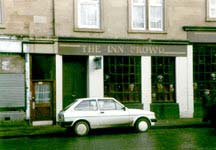
The Inn Crowd. 1991.
This is part of the Woodside Inn.
136 Queen Street, Glasgow. G1 Tel: 01412219330.
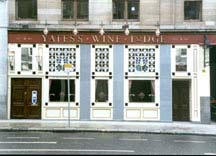
Yates Wine Lodge. 1991.
Over the years this old established pub has had many name changes in recent years it has been known as The Ingram Bar, Yates Wine Lodge and Drouthy Neebors, today the title above the door is back to The Ingram.
There has been licensed premises on this site since 1916, landlord John MacKenzie Caldwell ran the public house until the end of the First World War. Another well known publican to run the Ingram was Donald MacLean who took over in 1944. The original Ingram Bar was located in Ingram Street, however the licence was transferred to it’s present site on Queen Street when the old Ingram Bar was demolished.
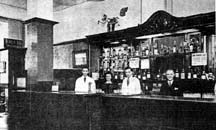
Interior view of the main bar, Ingram Bar. 1945.
Donald MacLean was born on the Isle of Skye, when he came to Glasgow he worked in the kitchen of the Central Hotel, afterwards becoming a waiter there. He gained further experience in the trade at the Royal Hotel, Oban and Gleneagles Hotel and spent ten years in the Grosvenor Hotel, Glasgow. He then when on to own his own pub in 1938 at 339 Cathedral Street. The Ingram consisted of the main bar and small dining rooms.
Jean Hannah an old lady that worked in the premises for many years was established as Secretary of the business. Mr MacLean had many interests, he was a member of the Glasgow Licensed Trade Defence Association, he took a keen interest in the Glasgow Skye Association, he also liked the works of Rabbie Burns and was a member of the Royalty Burns Club. During the war he served in the Clyde River Patrol.
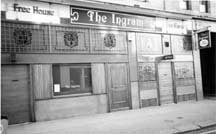
Exterior view of the Ingram Bar.
In the News 1973…
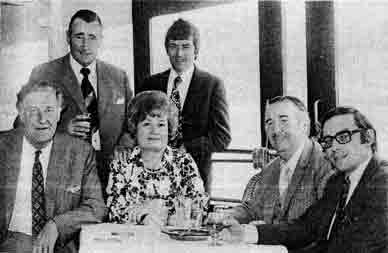
Mr. A. M. Don (Dunn & Moore), past president, and Mr. A. Sutter (Buchanan Booth’s Agencies) standing. Seated, Mr. A. Stewart (Buchanan Booth’s); Mrs. E. Prosser; Mr. J. Brown (Ingram Bar); and Mr. P. Taylor (Albany Hotel). 1973. This photograph was taken at the annual outing of the “BEN” (Scottish Wine and Spirit Merchants’ Benevolent Institution.
Also see Yates’s, Sauchiehall Street.
In 1978, Mr. Jack Brown, one of Glasgow’s noted licensed trade personalities, for many years proprietor of the Ingram Bar, Queen Street, Glasgow, has died in hospital, aged 68. He is survived by his wife, one son, Jack, who runs the Shaws Bar, Westwood Road, Pollokshaws, Glasgow, and one daughter, Marlene.
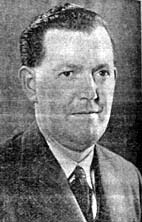
Donald MacLean. 1945.
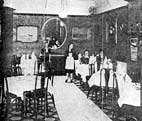
Interior view of the dining room, Ingram Bar. 1945.
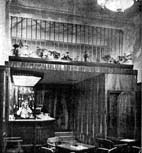
Interior view of the Ingram Bar. 1950s.
6 Howard Street, Glasgow. G1 4AZ.Tel: 01412218217.

Click here to read review for this pub
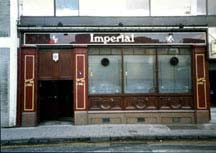
Imperial Bar. 1991.
This is one of those pub in the city that has been here for years and very few people known exists.
To read the full history of this old establishment Keep an eye out for our second book here.
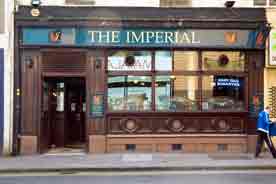
The Imperial Bar. 2008.
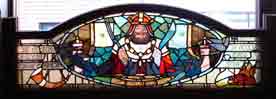
The Imperial Bar has three unusual stained glass windows this one is of a King having a feast.
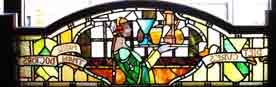
This one is of a barmaid serving drinks.
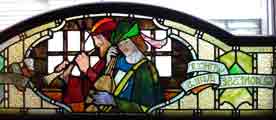
Two entertainers playing music. All these images have a theme of what a public house has to offer. 2008.
588 Broomloan Road, Ibrox,Glasgow.
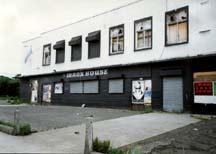
Ibrox House. 1991.
The Ibrox House sat at the corner of Broomloan Road and Paisley Road West.
The upstairs lounge / night club was known as the Mucky Duck, Satellite City and Maddison’s. When it became known as Maddison’s it was so rough it was known locally as Mad Dogs. With all these name changes the trouble makers still flocked and became known as a cutthroats joint a stab inn. Ibrox football stadium was close by this attracted many Rangers football fans. The place was finally closed down, the local Police were overjoyed at the result and was bulldozed around 1992 shortly after the photograph was taken above.
A petrol station was built on the site.
However the Ibrox House was not always that bad. When the McGinn family started out in Ibrox House it was a thriving family business.
Bonfire made from Gorbals Pub.
On V. J. night a celebrating crowd broke into Thomas McGinn’s pub at number 251 Rutherglen Road, Gorbals, and made a victory bonfire. The frenzied crowd tore up the floor boards, the shelves and the gantries, stripped the walls the seats everything to make a bonfire on Rutherglen Road, even the large barrel of McGinn’s special blend of old Scotch whisky “Ye Olde Judge” was set ablaze.
But Mr McGinn celebrated his own victory with the opening of a magnificent new road house situated just off Paisley Road West in Broomloan Road. A short distance down the Broomloan Road was Ibrox Stadium home of Rangers F.C. Appropriately Mr McGinn named his new premises Ibrox House.
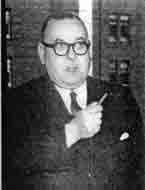
Mr Thomas McGinn.
He could scarcely have chosen a more ideal spot. In addition to the football stadium there was also the Albion and White City greyhound racing tracks close by as well as Ibrox Station. Mr McGinn was invalided out of the R.A.F. two or three weeks before the celebrating crowd destroyed his Rutherglen Road premises. For the next 12 months he was in Hospital and for six months he was convalescent. He was unable to restore his premises because it was not then possible to obtain a timber permit. Then came the next blow. His premises were compulsorily acquired by the City Council for demolition to make way for the new improvements to the Gorbals. Although he also held the licence for premises at 246 Paisley Road Mr McGinn began to look around for premises to replace the Rutherglen Road pub. His idea was to have large new premises that would be a credit to the city. At the corner of Broomloan Road and Paisley Road West he found the idea site. His application to the Licensing Court proved successful, but he had to surrender the Paisley Road licence.
Mr McGinn was assisted in his premises by his two sons and daughter, Paul manager, Thomas jun and Patricia (Mrs. R G Watt.) And traded under the title of Thomas McGinn & Sons. Ibrox House had its motto: Semper Idem (Always the Same.) On the crest was a crown the road house was built on crown property. In the center was the letters I. B., which stood for Ib Broch, which means the home of the badger. Underneath between the works Semper and Idem was a badger’s head.
On the ground floor of the premises was a spacious well appointed public bar, the bar itself extended the full length of the room. It was estimated that 1800 pints can be served in an hour. There was plenty of comfortable seating accommodation. Upstairs was a bright lounge bar and restaurant with seating accommodation for 120 people. Ample car parking space was also provided.
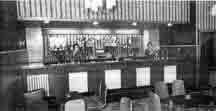
Interior of Ibrox House. 1958.
Mr McGinn himself declared the premises open in 1958 when he invited a large company of Trade personalities, in which wholesale houses were well represented and friends to the opening ceremony. Among those at the top table were Mr Balfour, director of William McEwan & Co Ltd., Mr MacDonald manager of McEwan’s and Mr A Don manager of G & C Moore Ltd. Mr Balfour’; speaking after the luncheon, said that the Ibrox House marked the fulfillment of a dream the McGinn’s have had for many years. That day the dream had become a reality. They had to congratulate Mr McGinn on three points. The site chosen could not have been a better one; the building represented the idea of what a public house should be. The business was a family concern. Mr Balfour then proposed a toast to Ibrox House and to the McGinn family.
Paul McGinn took over the licence on 13th May 1973.
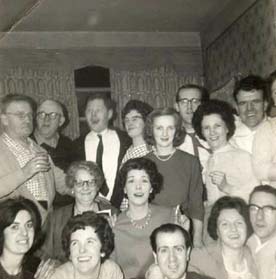
The McGinn family 1960s.
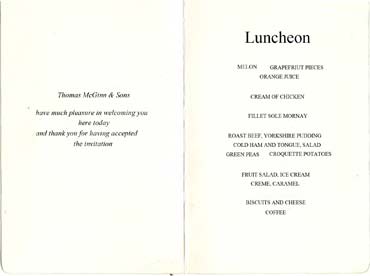
A copy of the original invitation menu…
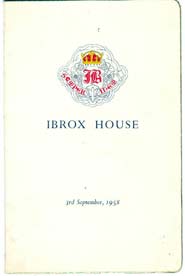
Ibrox House Invitation and Menu 3rd September 1958.
In the News 1971…
Along at Ibrox House the specialties are Steak Provincal and Scampi Provincal. Martin, the young chef there, has created a sauce which gives his dishes a flavour all of their own. He claims you can get the sauce nowhere else in the world and hopes to call his dish Steak Martine. It sounds good and, more important, tastes excellent.
Next door to the restaurant is the lounge, where our old friends Abie and Skip are on stage on Thursdays, Fridays and Saturdays. Although there are only two of them the boys give a big fat sound and work a lot of comedy through their routine. They try to make it a party night rather than just a night out in a musical lounge. In these days where it is difficult to get good food consistently this restaurant come with my recommendations.
Other Broomloan Road Pubs…
170 Port Dundas Road, Glasgow.
The Old Hundred Acre Inn sat at the corner of Port Dundas Road and 2 Forth Street. This old inn is said to have a date of 1799 and the licence had continued in unbroken line. I have a different view of this old inn, it was indeed an old established business dating from the 1830s, landlord Alexander Wright held the licence for five years, his wife then took over the certificate for a further five years.
Over the years publicans came and went until 1879 when Daniel Boyle acquired the business, when Mr Boyle passed away around 1893, his wife Bridget took over the business. She was very successful here but sold the inn in 1906 the inn closed for good in 1907.
Mrs Bridget Boyle had a thorough training to the business, her late husband showed her all that was needed to run a wine and spirit business, it was in her favour that she took everything in, as it wasn’t long before she had to do all the ordering and stock the old inn with good liquor.
License Holders.
1831-1840 Alexander Wright.
1845-1855 Mrs Wright.
1860-1865 Robert Goold.
1870-1873 Joseph Spence.
1875-1878 James Baker.
1879-1892 Daniel Boyle.
1892-1905 Bridget Boyle.
1906-1907 Mr J McGuckin.
Other pubs on Port Dundas Road…in 1899.
1 Port Dundas Road sat at the corner of Cowcaddens, the Gushet Bar, owned by Robert W Armstrong.
29 Port Dundas Road sat at the corner of 21 Garscadden Street owned by William Aird.
31-33 Port Dundas Road was owned by James Sloan.
34 Port Dundas Road was owned by William Hillcoat.
40 Port Dundas Road was owned by James Gilmour, this pub became known as Bennet’s Bar.
55 Port Dundas Road, the Station Bar was owned by Philip Duffy.
86 Port Dundas Road was owned by John Alston.
90 Port Dundas Road sat at the corner of 77 Milton Street, owned by Peter N Roy.
564-66 Springburn Road, Glasgow.
This old Springburn landmark was established in 1871 by wine and spirit merchant John Hughes. Other members of his family owned pubs at 588 Springburn Road, and 147 Springburn Road, (Caley Bar.)
John ran this old pub until 1875 then Andrew Hughes took over the license. He continued to run the pub with success and was closed down before the First World War. This old pub was situated right next door to the Stag Inn.
During the 1970s Alexander Massey & Sons Ltd Grocers was trading on the same site.