• Skip to primary navigation
  • Skip to main content
  • Skip to primary sidebar
Old Glasgow Pubs

Old Glasgow Pubs

  • Home
  • About Us
  • Find A Pub
  • Find Address
  • Find A Publican
  • Further Reading
  • Shop
  • Contact Us
  • Members Area
  •  
  • Click Here to Search the Site
You are here: Home / Archives for Address C

Address C

The Variety Bar

March 26, 2017 by John Gorevan 1 Comment

10 Cowcaddens, Glasgow.

Veriety Bar

The Variety Bar was named after John Mullen and Scots comedian who performed under the name of Jock Mills.

To read the full history of the Variety Bar and Jock Mills click here.

Variety Bar cowcaddens2

Another view of the Variety Bar.

Variety interior

Interior view of the main bar.

Variety Bar interior1

Interior view of the lounge.

Jock Mills Group

The committee of the Royalty Burns Club. 1933. The photograph was taken at an annul outing at Portsonachan, Loch Awe. Left to right standing Jock Mills, Archibald Wilson, John Macrae, Murdoch Macrae, William Jamieson and James C Gray (Secretary.) front row George McCartney, vice-president, James Denholm, president, John Aitken, immediate past president.

Elroy, Jock Mills, George Mills

Elroy, the well known armless music hall star, who uses his feet as hands, is seen here in the Variety Bar, Cowcaddens, with manager George and Jock Mills. 1949.

Jock Mills 1950

John Mullen (Jock Mills). 1950.

Filed Under: Cowcaddens, Cowcaddens street, V

Tirconnail Bar

March 26, 2017 by John Gorevan 1 Comment

173 Cumberland Street, Gorbals.

TRYING TO GET IN TOUCH WITH MARIE GALLAGHER OR ANY OTHER MEMBER OF THE GALLAGHER FAMILY. If you know a member of this family please let them know I am trying to get in touch with them……..

The Tirconnail Bar was a real favourite for the locals in the Gorbals. Owned by well known and respected wine and spirit merchant Hugh Gallagher. Mr Gallagher was president of the Glasgow Licensed Trade Benevolent Association and played a prominent part in the Gorbals trade affairs for many years.

Hugh Gallagher 1963

Mr Hugh Gallagher. 1963.

The image above was taken on the occasion at e Gorbals ward function in the Grosvenor, Glasgow in 1963. Hugh was the social convener of the Gorbals Ward of Glasgow Association.

However the history of the pub goes back to the 1889 when partners David Bowman and James M Gardner acquired a licence to sell wines and spirits and traded under the title of Bowman & Gardner. Mr Bowman was living at 109 South Portland Street while Mr Gardner was staying at 9 Smith Street, Govanhill.

John MacLeod took over the business in 1906 and served the locals here until after the First World War, he also had premises in Darnley Street at the corner of Melville Street.

During the 1930s Andrew Ross junior was licensee, he and his father also Andrew Ross ran some of the best bars in the city of Glasgow. The Ross family were a prominent family in trade circles in and around the West of Scotland. Mr Ross wasn’t only a wine and spirit merchant he was also a brewers agent. Mr Ross senior also held a certificate for 160 Woodlands Road (Halt Bar). Andrew Ross jun. took over the running of Samuel Dow’s premises in the 1940s. Samuel Dow married Mr Ross’s daughter.

In 1957 Hugh Gallagher took over the bar and changed the name of the pub to the Tirconnail Bar. Hugh was a cousin of Charlie Sweeney (Citizen Bar) and Anna Heraghty (Heraghty’s Bar.) Hugh also went on to own the Govanhill Bar on Thistle Street gushet in 1970. Also see The Glenbervie Bar, one of Hugh’s pubs, and 32 Raglan Street.

Hugh Gallagher group photo 1963

1963 image of the Gorbals group at the Grosvenor, Glasgow.

Left to right, Raymond McCrudden, vice convener; Mrs McCrudden; Hugh Gallagher, convener; Mrs Gallagher; Mr Thomas Flynn, president of the Glasgow and District Licensed Trade Defence Association; Mrs Hutchison and Mr Hutchison of White Horse.

Glasgow Licensed Trade Defence Association 1964

The Glasgow Licensed Trade Defence Association 1964.

Seated left to right: W J McDowall, secretary; J W MacFarlane, honorary treasurer; T F Flynn, president; A Morris Barr, senior vice president and R B Chassels, junior vice president. Standing J S Chalmers; J Cummings; D A Maclean; J McCarroll; M Macleod; J Gow; G Ramster; G A Grier; R McLean; R T Grier; J G Walls; J Millen; J Simpson; R Lemon; P R McCrudden; J Ward; Hugh Gallagher; S Whitton; D M Munro; T Mcauly and J D McLaughlin.

Gorbals ward 1965

Members of the Gorbals Ward Licensed Trade Association 1965. Back row J Thom, J Heraghty, N Douglas, C Sweeney, J K Webster. Front row P McGovern, H Gallagher, S Falconer, R McCrudden.

Gorbals group 1966

J Hargan, “Normal Bar”; Charlie Sweeney “Citizen Bar”; J Dickson “Moss End Bar, Bellshill”; A McAuley “Pig & Whistle”; Mrs J Dickson; D Welsh “Teachers”; Mrs Welsh; Hugh Gallagher “Tirconnail Bar”; Mrs A McAuley; Peter Gallagher “The Havana Bar”; A Ward “Ship Bank”. 1966. This image was taken during the annual trip outing of the Gorbals publicans and friends to Glendaruel. These trips were orginised on a Sunday as the pubs were still not permitted to open on the Sabbath.

Citizens interior1

The Citizen’s Bar wins the Cutty Sark darts competition 1967, F Munro, Cutty Sark congratulates Charlie Sweeney and his team. Below is the runners up Mr Munro congratulates Mr Hugh Gallagher and his team, Tirconnail Bar.

Hugh Gallagher 1968

Camphill Ward retains the Tennent Trophy. 1968.

Some of the competitors, from leff: D Clugston, Bulloch & Co.; Hugh Gallagher; D Harkness, Bulloch & Co.; James A Murray, “Ye Land Inn” Gallowgate; John A Murray, “Murray’s Bar” Dalmarnock Road; J Boyle “The Waverely”; J Thom, Eglinton Street and John McCann “Mally Arms”.

For the second successive year the Tennent Bowling Trophy, competed for annually by Glasgow city wards under local veto auspices, and played at Wellcroft, was won by Camphill.

After the game, Mr Donald A Maclean, president of the Glasgow and District Licensed Trade Defence Association, officiated at the prize giving ceremony, at which Mr D A Lowley, area manager, Tennent Caledonian Breweries, handed over the cup to the winning rink and prizes to the winners and runners-up.

The winning rink was skipped by John Flynn, who was assisted by J Hay, T M Armstrong, S Campbell. The runner-up, Hutchesontown, comprised Jack Morrison, skip; Angus Morrison; Murdo MacLeod and D A MacLean.

The six other rinks competing were Shettleston, Dalmarnock, Calton, Fairfield and Gorbals. Among those in attendance were T F Flynn, chairman of the Scottish Licensed Trade Veto Defence Fund; Jack Gow, the senior vice president; John M Smith, secretary of the fund and J C Campbell, Glasgow and West of Scotland area organiser for the fund.

Present also was George Ramster, secretary of the Glasgow Association, who came in for a special word of praise from Mr MacLean for his handling of the arrangements for his work behind the scenes.

Mr T F Flynn expressed thanks to Tennen Caledonian Breweries and to Mr MacLean for his presiding. Although not treated well by the weather, a heavy shower interrupted play for a while, all those taking part found the event most enjoyable.

Heraghtys interior 1972

The last night at the Garryowen Bar, Norfolk Street, in the picture is Mr & Mrs Heraghty, D A MacLean (Phoenix); H Gallagher (Gallagher’s Bar); J McKell (Turf Bar); S Falconer (The Matelot); E O’Doherty (Hampden Bar); P McGovern (Central Bar); J McCann (Mally Arms).

Gorbals Group 1974

Gorbals group photo 1974. The image includes Mrs M Mallarky; Charles Sweeney; Michael Heraghty, convener and Mrs Heraghty; G Watt (Bell’s Whisky); E O’Doherty; Mrs O’Doherty; H Gallagher and Mrs Gallagher; J Donaghey and Mrs Donaghey.

Charles Sweeney Gorbals8

Good days bowling 1974. H Gallagher, R McCrudden, C Sweeney, E O’Doherty, W McCann, W Coggans, A Jordon, C Duncan.

Charles Sweeney Gorbals7

Gorbals night out 1974. left to right G H Ramster, Mrs Ramster, H Gallagher, Mrs Gallagher, Mrs Sweeney, Mr C Sweeney, Mrs Munro, Frank Munro.

Filed Under: Cumberland Street, CumberlandStreet, T

The Three Craw’s

March 26, 2017 by John Gorevan Leave a Comment

501 Crow Road, Glasgow. G11 2DN. Tel: 0141 958 1221.


Check back soon for the history of this pub.

Filed Under: Crow Road, CrowRoad, T

Thomas Brownlie’s Tavern

March 26, 2017 by John Gorevan Leave a Comment


Carrick Street, Anderston, Glasgow.

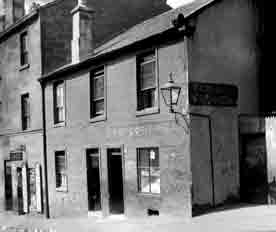
McDean's Bar Carrick Street

Thomas Brownlie’s old pub, Carrick Street.

Thomas Browlie sold Herb Beer from these premises as the dark sign on the side of the building is an advert for Herb Beer, Brownlie.

This was the birthplace as Artist William Simpson. Born into poverty in Glasgow on 28 October 1823, Simpson went on to become one of the leading ‘special artists’ of his day, and sketched many scenes of war for the Illustrated London News. His early years were very difficult living in a house with an abusive and alcoholic father, and in 1834 he was sent to live with his grandmother in Perth. Simpson’s only formal schooling took place during this period and within a few years, he was working as an apprentice in the Glasgow lithographic firm of Macfarlane. The artist stated later that “this was the turning point which changed all my boyish intentions.” It was during the years in Glasgow that he attended the Andersonian University and the Mechanics Institute in the evenings. His next position was with the lithographic company of Allan and Ferguson where he spent four years learning the trade.

In 1851 Simpson moved to London where he was hired by Day & Sons. While at Day’s he was able to work on several important lithographic sets.

He became famous initially for his work in the Crimean War where he was sent by the firm of Colnaghi to create a series of watercolors suitable for lithographing. In the late 1850’s he was sent to India to sketch scenes relating to the recent Sepoy Revolt. He joined the ILN in 1866 and covered the Abyssinian Campaign of 1868. In 1870 he went to France to sketch the war with Prussia, and in the following year observed the barricades of the Paris Commune. During a trip around the world, he stopped off in California and traveled to the Lava Beds area to report on the Modoc War in 1873. Five years later, he journeyed to Afghanistan to provide illustrations of the Second Afghan War that had broken out; he returned to London in the summer of 1879. In 1890, he observed the opening of the Forth Bridge and caught a chill which was to have detrimental effects on his health.

He died at home in Willesden, north London, on August 17, 1899, and was buried in Highgate Cemetery. Besides his war pictures, he covered state events, coronations, funerals, and other ceremonies. He was particularly interested in India and sketched scenes of the Kashmir Maharajas.

Simpson was a noted ethnographer and antiquarian, and wrote extensively on ancient religions, customs, and ancient artifacts. During his time in Afghanistan, he excavated several ancient Buddhist topes. He was a frequent visitor to Windsor and Balmoral, and Queen Victoria acquired a number of his works. It is said that she intervened to prevent him from going out to Italy in 1859 to cover the Austro-Sardinian War, for fear that he would get killed.


Taken from Wikipedia


Filed Under: Carrick Street, CarrickStreet, T

Taylor’s

March 26, 2017 by John Gorevan Leave a Comment


52-58 Cowcaddens Street, Glasgow.

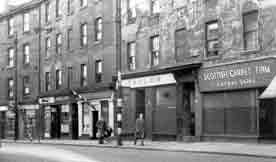
Taylor's Bar Cowcaddens Street

Taylor’s Bar. 1963.

Filed Under: Cowcaddens, Cowcaddens street, T

Tennent’s Bar

March 26, 2017 by John Gorevan Leave a Comment

191 Byres Road, Partick, Glasgow. G12. Tel: 01413411024.

Tennent's

Tennent’s Bar. 1991.

Hugh Tennent jun. obtained a certificate to sell wines beers and spirits from premises on this site since 1888. A new tenement was built on the site with a new public house for Hugh Tennent in the 1890’s.

Hugh Tennent jun. was the grandson of the Hugh Tennent of Wellpark Brewery, Duke Street. He was born in Tasmania in 1842. In 1871 he established the Wellshot Brewery in Cambuslang, when he gave up brewing in that district he became a wine & spirit merchant in Clydebank, Glasgow, Rutherglen and Whiteinch. His establishments were run like clockwork with all the newest equipment installed, he dispensed in large polished wooden barrels his own single malt called “Royal Brackla.”

In 1881 he was living in Wellshot House, Rutherglen with his housekeeper Barbara Kennedy and a domestic servant Jeanie McDonald, he was still a single man at this time employing 30 men and 7 boys in Wellshot Brewery.

Hugh Tennent jun died in 1919, his son George Beaconsfield Tennent took control of the public houses and other businesses his father had going at the time. However there was a dark secret Hugh Tennent jun kept to himself which later came out after his death, he had another family and mistress, a court case that was continued until 1955.

When Hugh Tennent died in 1919 he left two families one of 4 children by Ellen Clarke and one of 11 children by Rebecca Whaley and an estate valued at £70,724.

James Wilson judicial factor of the late Hugh Tennent stated that there were 13 defenders, most of them living in the Glasgow area, were believed to be all the children and heirs of Tennent, Mr Wilson also stated that there might have been others who had gone abroad and who could not be traced.

Tennent in his will and codicils, made provisions which included the payment of an annuity of £1500 to his widow, Rebecca Whaley Tennent. He also provided that his trustees should hold the residue of his estate, including and surplus annual income, for his children equally in liferent and to their respective issue equally per family in fee until the death or remarriage of his widow. Mrs Tennent died in June 1953.

The question of fact in the case, was who were the legitimate children of the testator. Of the four children by Ellen Clarke only one Hugh Tennent, Tantallon Road, Glasgow survived. The latter contended that the testator and Ellen Clarke were married at Mount Florida, Glasgow in 1873 or 1883 by interchange of consent or by the Rev. Henry Drysdale of Mount Florida Church.

It was argued by counsel for the other claimants that no declaration by the testator after the death of the woman was relevant since it could not be communicated to her. They argued that the testator was never married to Ellen Clarke and accordingly all the first family were illegitimate.

The Judge said this was a case in which it was sought to establish a marriage between and man and woman who had been in the position of mistress and keeper. In those circumstances he believed it necessary to have clear evidence in support of the marriage.

There appeared to be no evidence whatsoever to establish a marriage by declaration in 1873 between the testator and Ellen Clarke. This would have had the effect of making the three elder children of Rebecca Whaley illegitimate. If it had appeared from the evidence of Hugh Tennents housekeeper Miss Kennedy that she had been present at a death bed ceremony it might have been possible to spell out the declarations made by the testator subsequent to the death of Ellen Clarke, corrobation for that evidence.

The Judge said he regretted in some respect that he had not been able to find evidence sufficient to establish a death bed marriage on January 10 1883, since if that had been established it was admitted that all the children would be legitimate and entitled to share equally in the fund.

Three Judge's 2007

The Three Judge’s. 2007.

Tennent’s Bar today is as popular as it was when it opened it’s doors for the first time. If you like a cheap lunch and a good pint this is the place for you.

Facts…

There are three Judge’s in professional boxing. This is where the pub gets it’s name. Not that there are fight’s in this pub, the exact opposite, this is a great place for a drink.
When I last visited the Three Judge’s the resident Jazz band was playing, what a great atmosphere.
Real ale is very popular in here too. It’s a real gem of a place.

Filed Under: Byres Road, ByresRoad, T

  • « Go to Previous Page
  • Page 1
  • Page 2
  • Page 3
  • Page 4
  • Page 5
  • Interim pages omitted …
  • Page 21
  • Go to Next Page »

Primary Sidebar

Become a Member of Old Glasgow Pubs

We are very excited to announce that we have created a new membership! In return for supporting the site, you will gain fantastic perks! Click below to find out how you can support the site!

💖 Donate via PayPal

All content on this site is Copyright Old Glasgow Pubs (OGP). To use any history or images, please make sure you link back to our site.

This website uses cookies to improve your experience. We'll assume you're ok with this, but you can opt-out if you wish. Cookie settingsACCEPT
Privacy & Cookies Policy

Privacy Overview

This website uses cookies to improve your experience while you navigate through the website. Out of these cookies, the cookies that are categorized as necessary are stored on your browser as they are essential for the working of basic functionalities of the website. We also use third-party cookies that help us analyze and understand how you use this website. These cookies will be stored in your browser only with your consent. You also have the option to opt-out of these cookies. But opting out of some of these cookies may have an effect on your browsing experience.
Necessary
Always Enabled
Necessary cookies are absolutely essential for the website to function properly. This category only includes cookies that ensures basic functionalities and security features of the website. These cookies do not store any personal information.
Non-necessary
Any cookies that may not be particularly necessary for the website to function and is used specifically to collect user personal data via analytics, ads, other embedded contents are termed as non-necessary cookies. It is mandatory to procure user consent prior to running these cookies on your website.
SAVE & ACCEPT