7 Park Terrace, Glasgow.
La Bonne Auberge 7a Park Terrace, Glasgow Advert 1976.
Many will still remember this great westend venue near Park Circus.
7 Park Terrace, Glasgow.
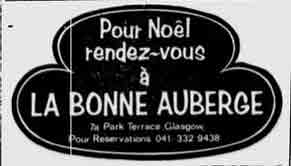
La Bonne Auberge 7a Park Terrace, Glasgow Advert 1976.
Many will still remember this great westend venue near Park Circus.
161 West Nile Street, Glasgow. G1 2LR. Tel: 0141 352 8310.
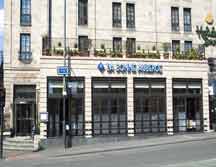
La Bonne Auberge Brasserie. 2007.
La Bonne Auberge Glasgow Theatreland takes pride in being one of the few Glasgow restaurants to still be going strong after forty years.
La Bonne Auberge, Glasgow’s original Mediterranean Brasserie, continues to thrive and innovate under the guidance of our award winning Executive Head Chef, Gerry Sharkey. Using only the freshest ingredients, the menus offer excellent value for money and tantalising cuisine inspired by France and the Mediterranean.
Surrounded by some of Glasgows top theatres such as the King’s, Theatre Royal and Pavilion Theatre, as well as Glasgow Royal Concert Hall, La Bonne Auberge offers the perfect venue for pre-theatre and à la carte dining. For functions and special occasions we offer private dining in our Montmartre Suite also, and why not make a night of it and stay over at the Holiday Inn Glasgow Theatreland that is just footsteps away!
LA BONNE AUBERGE
GLASGOW THEATRELAND
To read more on La Bonne Auberge in Park Terrace near Park Circus. Click here.
26 Springfield Court, off Buchanan Street, Glasgow. G1 3DQ.
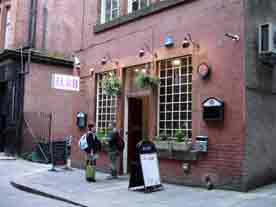
The Lab. 2008.
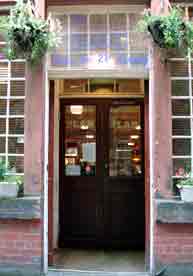
Front door of the Lab. 2008.
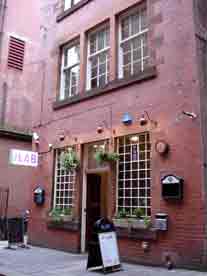
The Lab. 2008.
148a Holland Street, Glasgow. G2 4NG. Tel: 0141 332 2159.

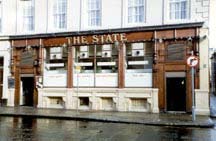
The State. 1991.
In 1905 Philip MacSorley obtained a licence for new pub on Holland Street. Philip started his career as a publican in 1886 when he owned a small public house on Pollokshaws Road in the south side of the city, this pub used to sit facing Dow’s old pub near the gushet of Pollokshaws and Kilmarnock Roads.
Over the years Philip MacSorley owned some of the best pubs in the city including Garngad Road, many will still remember this old pub as the Stop Inn, The Roost, Dumbarton Road, Maitland Street, and MacSorley’s in Jamaica Street. Mr MacSorley also owned his own special blend of Scotch whisky called the “Peacemaker.” He also owned the University restaurant in Sauchiehall Street.
In the 1930s Daniel C Grant was running the State Bar and for the next twenty years the pub stayed in the same family. Daniel was the son of John Grant founder of John Grant Wines & Foods Ltd who controlled Rogano, Grant Arms, the Royal restaurants, the Grand Central Hotel, Belfast and various other establishments in the West of Scotland.
Daniel was born in Glasgow and educated at St. Aloysius School, Mr Grant trained as an engineer and served in the Royal Flying Corps during the First World War. On return to civilian life he entered business with his father. On his father’s death in 1945 Daniel became controller and managing director of the firm. His father left a fortune in his estate valued at £870,205. He owned a vast amount of liquor which included 43,689 gallons of whisky, which realised £655,342 at the rate of £15 per gallon and also several thousands of gallons of port and sherry. Wine and spirits in premises owned by him were stated in the inventory to be worth £46,163, while his wholesale wine and spirit business and the Grant Arms, Argyle Street realised £20,000. He left £200 each to his domestic servants who looked after his house at Queensbourgh Gardens, west end.
In 1955 Mr Grant left the firm to branch out on his own with his two sons and daughter to form Rogano Ltd, controlling Rogano restaurant and a wholesale wine and spirit merchants business in Glasgow. Mr Grant was one of five Scottish members of La Conferrers des Chevaliers du Tastevin, which was an exclusive brotherhood of wine tasters of Burgundy.
In his spare time he was regularly seen angling on Loch Tay and shooting at Aberfoyle. Daniel died in 1957 aged 57, leaving his wife two sons and a daughter.
Another well known and respected publican to own the State was Raymond McCrudden, Raymond took over in 1973 and renamed the pub His Nibs. When he took over the pub he couldn’t decided on a name for the pub, his son came into the bar while refurbishment was going on, he took off his coat and Raymond noticed the label on the coat His Nibs, so the name went above the door for a while. Mr McCrudden also owned some of the finest bars in Glasgow including the Inn, Old Eagle Inn, and the Mitre Bar, Brunswick Street.
Formerly known as Lymburn’s and Shadows.
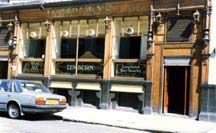
Lymburn’s. 1980s.
In the News 1972…
Well-Known City Pub Loses Its Licence
The licensee of the State Bar, one of Glasgow’s best-known pubs, was refused a renewal certificate at the Licensing Court this afternoon.
Mr John Grant, who has held the licence since 1959, is to appeal at the next sitting of the Appeal Court on April 4. His licence expires on May 27.
The magistrates refused by eight votes to six to renew Mr Grant’s certificate after police objected about under-age drinking at the bar at 148 Holland Street, near Charing Cross. Assistant Chief Constable, Mr Elphinstone Dalglish, said there had been five cases of under-age drinking since Mr Grant had acquired the licence.
he told the magistrates that on January 14 police raided the bar and found a number of people, all under 18, drinking, eleven were accused. Mr Dalglish referred to other cases, two in 1969, one in 1970, and one in 1972.
Mr Ian Kirkwood, QC, appearing for Mr Grant, said the four previous cases had occurred before the last sitting of the court and had not affected his licence then. He did not think this was relevant for consideration today. The main objection submitted by the police, he said, was based on January 14.
Mr Grant employed a part-time doorman to supervise one of the main doors while he watched the other. On this occasion the man was late in arriving and a number of people entered the door not supervised by Mr Grant.
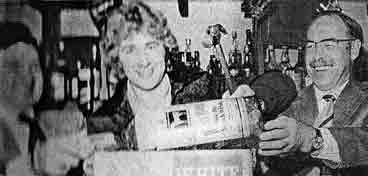
Scottish International goalkeeper Alan Rough (centre) changed his role to that of a striker when he smashed open a whisky collecting bottle at His Nibs public house in Holland Street, Glasgow. The slotted bottle, one of 200 donated by White Horse Distillers to the Scottish Taverners, contained £189. Proprietor Raymond McCrudden (left) expressed thanks to all the customers who regularly donated. On the right is Dougie Wood, of White Horse. 1979.
Click here to read the review of this pub
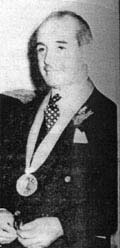
Mr Daniel Grant. 1950s.
Do you remember this old Pub, If so please leave a comment.
End.
255 Buchanan Street, Glasgow.
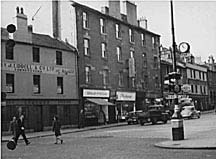
Lymburn’s was situated at the corner of Buchanan Street and Sauchiehall Street. The photograph here was taken from Buchanan Street side in the 1963.
In 1875, wine & spirit merchant Hugh Lang owned this establishment along with licensed premises in Argyle Street and Broomielaw.
In 1896 Mungo Fairlie Wilson acquired the premises, he occupied it until 1908. Robert Brownlie Fleming took over the licence in 1909 and continued to run a successful business well after Second World War.
Henry Stirling Lymburn put his name above the doorway from the late 1950s until it was demolished in the 1960s. Mr Lymburn was well established in other well known pubs in the city, he had premises at 519 Dumbarton Road and 431 St. George’s Road.
33 Cowcaddens, Glasgow.
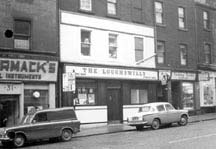
In the 1870s Alexander Cameron was landlord here, his son also Alexander owned a small pub at 147 New City Road.
From 1889 to 1904 Stewart Wright Christie owned the property, he was a successful wine and spirit merchant who sold the pub to Hugh Miller. Mr Miller continued as licensee through the hard war times of WW1.
The McGarvey family will probably still be remembered by many locals who drank here in the 60s and 70s and even before that. Charles McGarvey ran the pub in the 1930s, he also owned a pub at 2 Swan Street, Port Dundas. In the 60s Christopher McGarvey was licensee, while there was a James McGarvey who had a pub at 938 London Road in the east end of the city.
The McGarvey family ran this old pub until it was demolished in the late 1970s. The last licence holder was Julia McGarvey Grail.