
457 Sauchiehall Street, Charing Cross, Glasgow. G2 3LG. Tel: 0141 352 7970.
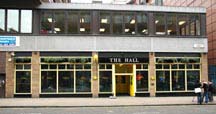
The Hall. 2005.
The Hall Tel: as above.
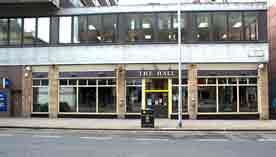
The Hall. 2008.
457 Sauchiehall Street, Charing Cross, Glasgow. G2 3LG. Tel: 0141 352 7970.
The Hall. 2005.
The Hall Tel: as above.
The Hall. 2008.
1578-82 Paisley Road West, Glasgow.
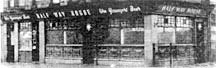
The Old Half-Way House. 1960s.
The old Half Way House was demolished around 1964. Manager of the premises before it was demolished was Mr Carmine di Giacomo.
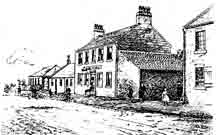
The Old Half-Way House Inn. 1893.
The Half-Way House Village had a peculiarly interesting history and one of the most interesting buildings in it, the “Old Half-Way House Inn.” The village is half way between Paisley and Glasgow, and is hedged in by some of the best scenic splendors that can be seen in the West of Scotland. Crookston Castle is in the immediate neighbourhood, and the grim tradition that have been handed down from generation after generation have given the fictionist abundant material out of which he has woven romance. There is hardly a village in Scotland that can boast of so old an hostelry as the Old Half-Way House Inn. A stone in the front wall of the original house bears the date of 1608.
Some of the older inhabitants related many stories that make the blood pulsate quicker in the veins of the listener. It recalls to one’s mind the times when pedestrians were robbed and mail-coaches ransacked, in fact, it brings one back to the twilight of northern civilization. Many alterations have been made in the building, but substantially it remains what it was a hundred years ago. It was one of the best equipped and appointed inns that can be met with, and there is no lack of custom, no matter how unpropitious the time. On the ground floor alone there were eight apartments, while upstairs were five more. Attached to the house there was a large garden and a number of outside buildings.
One of the stories that one heard related of this ancient house, because it has the merit of being true. The incident occurred back at the beginning of the 1800s. It was on a dismal night in the December of 1800, two individuals entered the Old Half-Way House Inn and ordered refreshments. They were sweethearts, and when the refreshment’s were partaken of, the gentleman said in a jocular way to the woman, “You must stand this after me escorting you so far on the road.” “Certainly,” said the maid, and produced at the same time a guinea-note, which were in circulation at the time. The gentleman before handing it to the host scribbled his name on the back. When the change was returned, the man sat down a shilling in payment for the refreshments, and remarked that he was only joking about the money, and the girl, at the request of her sweetheart, was handed back the paper note. The girl was on her way to serve at one of the neighbouring farms, and her sweetheart had come all the way from Glasgow to convoy here there. After escorting his sweetheart to her new situation he returned to the Half-Way House Inn, and indulged in a fresh glass of liquor. While partaking of the beverage two men, excited and suspicious-looking, appeared at the bar. They presented a quinea-note for drinks. The sweetheart who had gone to the farm had that quinea-note in her possession when they parted, besides his autograph on the back. He recognised the note while standing at the bar, and at once insisted on the doors being closed. This request was immediately conceded to him, and a number of labourer’s arrived on the scene. There was the usual bustle and the two men were arrested and within a very short time the body of the girl was discovered within half a mile of the inn. In due course the men were tried and convicted, and their remains, while some alterations were being made in that grim churchyard in Jail Square for the bodies of murderers and other criminals, were entombed and identified. The foregoing is only one story of the many associated with the Old inn. Mrs Hunter the proprietor in 1893, was admirably adapted to carry on the extensive business that is done at the inn. The traditions of the Old Half-Way House Inn will not be allowed to suffer while she is in occupancy. She took a deep interest in the legendary lore of the district and can narrate a story with pith and power. Of a genial, kindly disposition, she is held in the highest esteem in the district.
Ibrox is half a mile from Glasgow and another mile brings the pedestrian to the Old Half-Way House Inn. There was two inns in the district, but the Old Half-Way House claims the largest patronage. A little behind the present house there is the original one, which bears the date of 1608.
239 North Street, Charing Cross, Glasgow. G3.
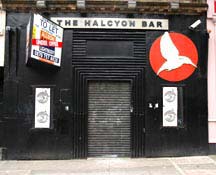
Halcyon. 2003.
Over the last few years this pub has tried to attract customers from the very busy Ritz Bar next door and has failed. It has now closed down, it was formerly known as the Jed Bar a Star Wars themed bar, the pub was flooded a few times before it closed it’s door.
33 Ingram Street, Glasgow. G1 1HA.
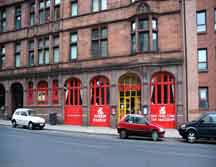
Gumbo. 2005.
Gumbo was formerly the Ingram Street Fire Station. The BIG red doors can still be seen, I wonder if this was intentional.
21-25 Bothwell Street, Glasgow. G2 6NL. Tel: 0141 248 6262.
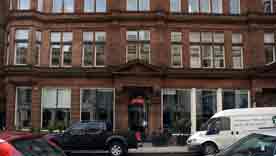
The Grill on the corner. 2008.
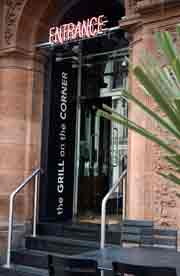
A nice warm entrance. 2008.
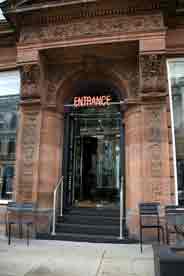
The Grill Doorway. 2008.
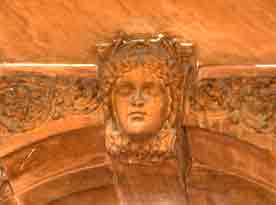
This image is above the doorway of the Grill . 2008.
Wines & Spirits.
244 Garscube Road, Glasgow.
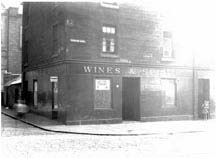
There has been a pub on this site since at least 1882. The occupier John MacLachlan of G & J MacLachlan of the Castle Vaults and Castle Blend of Scotch Whisky, also owned a public house on Park Road called the Blythswood Cottage.
Mr MacLachlan continued to run this pub until 1905 when he gave up the business to concentrate on his other establishment in Park Road.
John Griffin then took over the pub, he ran another establishment on Hospital Street on the south side of the city, which became known as the Turf Bar. The locals called it the Griffin.
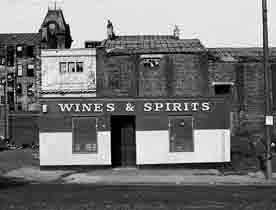
The Griffin.
As one can imagine, when you have a pub next to your close, you had to pass old winey’s on your way up the stairs, this wasn’t as bad, as, most nights you had to pass many of these drunkin bums pissin up the walls. It must have been a chore for the ladies washing the closes the following morning if they ever got cleaned at all.
The Griffin family continued to serve the locals in the Garscube Road establishment until it was demolished in the 1970s.