• Skip to primary navigation
  • Skip to main content
  • Skip to primary sidebar
Old Glasgow Pubs

Old Glasgow Pubs

  • Home
  • About Us
  • Find A Pub
  • Find Address
  • Find A Publican
  • Further Reading
  • Shop
  • Contact Us
  • Members Area
  •  
  • Click Here to Search the Site
You are here: Home / Archives for Finnieston Street

Finnieston Street

Dirty Dicks

January 8, 2017 by John Gorevan 2 Comments

175 Finnieston Street, Glasgow. G3 8HD. Demolished.

Image of Dirty Dicks bar 175 Finnieston Street dated 1938
Dirty Dicks. 1938.

Dirty Dick’s was a favourite haunt with sailor’s. To read more on the history of this once popular bar you will need to wait until Glasgow Pubs and Publicans Volume 2 comes out.

There has been a public house on this site since 1853, Thomas Welch ran a small public house on this site until 1860.

There were no records for anyone trading after this until 1865 when well-known and respected wine and spirit merchant J & R McIntyre acquired a licence to sell wine and spirits from these premises which was a new tenement with a public house on the ground floor.

Brothers John and Ronald traded under the title of J & R McIntyre and was trading from 1863 from premises at 179 Main Street, 35 Kelvinhaugh Street, and 43 Richard Street before taking over the new premises at 175 Finnieston Street.

Image of Dirty Dicks Bar 175 Finnieston Street dated 1948
Dirty Dicks. 1948.

The name of the pub then had J & R McIntyre above the door.

In 1870 John was living at 4 Gray Street just off Dumbarton Road while Ronald lived nearby at 9 Minerva Street. Ten years later the brothers had public houses at 50 Elderslie Street, 400 New City Road, 546 Dobbies Loan, 28 Burnside Street, 43 Richard Street, 49 Piccadilly Street, 35 Kelvinhaugh Street and stores at 16 Cranston Street.

In 1890 the brother were trading from 175 Finnieston Street, 179 Main Street, Cranstonhill, 50 Elderslie Street, 526 New City Road, 540 Dobbies Loan, 28 Burnside Street, 43 Richard Street, 49 Piccadilly Street and their offices still at 16 Cranston Street.

J & R McIntyre still traded after 1894 however the firm disposed on the Finnieston Street pub.

The next licensee was John H McLauchlin, John lived at 40 St Vincent Street and traded from Finnieston Street until the 1935.

From 1935 until the 1940s Patrick W McNulty was licensee, he also had a pub at 129 Oxford Street and resided at 87 Barnton Street, Carntyne, in Glasgow’s east end.

During the 1950s and 60s many will still remember James McLaughlan who owned the pub, he was the last licensee before the pub was demolished.

Image of Dirty Dicks bar 175 Finnieston Street dated 1955
Dirty Dicks. 1955.

Thanks to Glasgow Museums for this great image of Dirty Dicks which was taken by Partick Camera Club.

Facts…
Licensees…
1960-50 James McLaughlan.
1940 Patrick W McNulty.
1930-1894 John H McLauchlin.
1894-65 J & R McIntyre.
1960-53 Thomas Welch.
Also see Ship Inn Bar, Kelvinhaugh Street.

Do you remember this old pub? If so please leave a comment.

Filed Under: D, Finnieston Street, FinniestonStreet Tagged With: Dirty Dick's, Finnieston Street, Finnieston Street Pubs, J & R McIntyre, James McLaughlan, John H McLauchlin, John McIntyre, Patrick W McNulty, Pubs in the west end, Ronald McIntyre, Thomas Welch, West End

Artizan Vaults.

January 2, 2017 by John Gorevan Leave a Comment

3 Finnieston Street, Glasgow. Demolished.

Mr Robert C Kerr. 1897.

Wine and Spirit Merchant Robert C Kerr was born in Catrine, Ayrshire, Robert Burns country. Robert was educated at the village school. He started work very early in the cotton mills, cotton spinning being at that time one of the stable industries of Scotland.

Robert then went on to be a miner. What a change of occupation, from soft cotton to hard dark coal mining. Young Robert then can to Glasgow and worked in a large east end cotton factory. He then entered the spirit trade as an assistant in a pub owned by Mrs Armour, Stevenson Street, Calton.

Mr Kerr was very ambitious and mastered the trade, hoping to once own his own public houses. When the Anchor Tavern, 21 Argyle Street came on the market Robert jumped at the chance to be his own boss.

After acquiring the licence, business was good and seven years later opened the Artizan Vaults in Finnieston Street. Robert managed boss premises and was assisted by his son in the Anchor Bar. The Anchor Bar was located on the confines of the Trongate and in one of the busiest parts of Argyle Street.

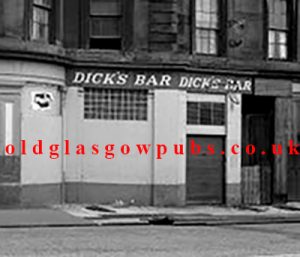
Dick’s Bar, 3 Finnieston Street. 1966.

The history of the Anchor Bar dates back to 1788.

When Robert took over the Artizan Vaults in June 1895 the place was in great need of refurbishment. Robert installed incandescent light throughout the pub and the rooms were both comfortable and well ventilated. One neat little snuggery, known as the “Cosy Den”. A new gantry and spirit rack behind the bar was among the handsomest in the area, the walls were decorated with pictures and mirrors.

There was a large cellar underneath the premises from which beer was raised in cool and perfect condition by a Bruce beer engine. All the best whisky and liquor was stocked in the Artizan.

Robert became a licence holder in 1889, entered upon the Anchor on the 17th October 1889;m obtained the transfer on the 17th December; bought the “Artizan” on 17th June, 1895; and obtained the transfer 17th April, 1896. Seven is surely his lucky number.

Dick’s Bar. 3 Finnieston Street.

The history of the Artizan can be traced back to 1867 when Wine and Spirit Merchant James Taylor acquired a certificate to sell wines and spirits at 3 Finnieston Street. James was born in Rutherglen.

By 1880 James was living with his family at 5 Finnieston Street and purchased another public house The Royal Bar, 328 Scotland Street at the corner of Watt Street. Five years later we find his residing at 115 Dumbarton Road before moving to 16 Strone Terrace, Dowanhill, so business was very good.

In 1881 James was living with his wife Janet Colquhoun with seven daughters and one son.

When Mr James Taylor passed away in the early part of 1890s his wife took over the business until 1895.

Robert C Kerr then took over the pub. Robert was living at 91 North Hanover Street in the city centre. He gave up the Artizan Vaults in 1898.

David Burrell then took over the pub and continued to serve the locals until 1908.

Another well-known and respected Glasgow Publican to own the pub was James McCondach, who ran the pub until the 1950s. Many will still remember Raphael Issacs in the 1960s before Mr John Dick took over the pub and renamed it Dicks Bar.

In the 1950s this old pub was known as the Cosy Corner. Maybe someone was renovating the old bar and saw a sign the “Cosy Den” in the snug bar and renamed the pub the Cosy Corner.

Do you know anything about this pub? If so please leave a comment.
END.

Filed Under: A, Finnieston Street, FinniestonStreet Tagged With: Artizan Vaults, Finnieston Street, Finnieston Street Pubs, Pubs on Finnieston Street, Robert C Kerr

Columba Bar

January 2, 2017 by John Gorevan Leave a Comment

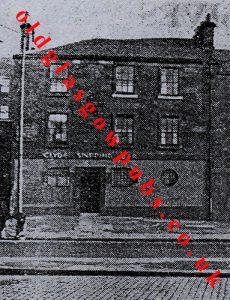
41 Finnieston Street, Glasgow. G3 8HB. Demolished.

Finnieston Street has always been well provided for in terms of drinking places, with all the sailors, mariners, boatmen, engineers from the quays nearby. The tills in all the pubs in Finnieston Street, Anderston Quay, Lancefield Quay and Broomielaw were filled with foreign currency as the customers came from all corners of the world.

The first licensee to own this pub was John Lawrence who obtained a certificate in April 1873. John was born in England in 1827. He met his wife and had a family in England before coming to Glasgow to set up business as a publican. In 1881 John was residing at 43 Finnieston Street with his wife Prudence, son William who was a butcher to trade and son John who assistance his father in the licensed trade.

John continued business here until 1907. In October 1908 the licence was taken over by Archibald Jackson. Mr Jackson refurbished the premises and putting his own decor into the pub and renamed the pub Jackson’s Bar.

Archibald Jackson made a good living out of the licensed trade. In 1921 he was living at 38 Randolph Gardens before moving to 58 Balshagray Avenue in 1941. Archibald’s also owned a public house at 82-84 Castlebank Street, Partick.

In 1919 Margaret Ann Swan Jackson was licensee of the pub on Castlebank Street. She was paying an annual rent of £65 for the pub.

During the 1960s the pub was licensed to Florence Mary McBride Jackson Griffins, she was also licensee of the Castlebank Street premises.

Throughout the pubs history only two different families owned it.

The pub was demolished in the mid 1960s.

Do you remember this old Pub? If so please leave a comment.
Filed Under: C, Finnieston Street, FinniestonStreet Tagged With: Archibald Jackson, Columba Bar, Finnieston Street, Finnieston Street Pubs, Florence Griffins, John Lawrence, Margaret Jackson

The Clyde Shipping Bar

January 2, 2017 by John Gorevan Leave a Comment

85-87 Finnieston Street, Glasgow. G3 8HB. Demolished.

Image of the Clyde Shipping Bar, *5-87 Finnieston Street, Glasgow
The Clyde Shipping Bar. 1950

There has been a public house on this site since 1850. The first licensee to acquire a licence for these premises was spirit dealer James Higgins. Mr Higgins continued serving the locals here until 1867.

William Richardson was the next spirit merchant to own this old pub. William lived with his wife and family at 1 Kent Road. By 1875 Mr Richardson also owned a public house in Cranston Street many will remember this old pub as the Prince of Wales Tavern. William continued to hold the licence until 1892.

In 1881 William Richardson was 56 years of age and living at 111 Finnieston Street with his daughter Mary.

The next gentleman to hold the licence was John Bathgate. John was also a restaurateur in Linthouse Hall, Govan. John only lasted a few years here and gave it up in 1895.

In 1895 John Fraser acquired the licence. John paid an annual rent of £90 for the premises. He lived at 30 Derby Street before moving to better accommodation at Comleypark, Dunfermline. Mr John Fraser continued in this pub until 1923.

Alexander S Donald then took over the licence in 1924. Alexander also owned the Clyde Vaults, 150 Gallowgate and a public house at 13 Green Street, Clydebank. Mr Alexander S Donald was the last person to hold the licence and the pub was demolished in the early 1950s.

In the News 1950…

The Clyde Shipping Bar at World’s End.

Iv’e been to the World’s End – not somewhere over the rainbow, but along the dreary congested Street of Glasgow’s Dumbarton Road to the once rural village of Finnieston where now giant cranes and multicoloured ship funnels tower up from the docks like giant ungainly flowers stretching to reach the sun.

It is doubtful if one in a hundred of the dockyard workers who daily stream up the Finnieston Main Street realises that they constantly pass World’s End, or if many of the customers who sip their beer in the Clyde Shipping Bar know that the pub looks into man-made “eternity.”

Pity that the Shipping Bar did not think to perpetuate this old Finnieston name and allow some artist’s imagination full scope to design a sign as unique as the name “World’s End Bar.”

There is certainly no doubt that the Clyde Shipping Bar, in spite of it’s modern front is entitled to associate itself with the oldest memories of Finnieston. It is housed in an old building built one believes in the early 1800s. At one time the building was an inn and between the grocer’s shop at one end and the pub at the other one can just discern the faint printing on the walls, “Finnieston Inn and Tavern.”

Below the grocer’s shop are the old inn cellars and above, where once the Finnieston Inn provided its humble hospitality, are dwelling houses out of one of which the day I passed that way trundled a little old man with a slice of bread for a cart-horse. It is a bitterly cold day and frankly, I was wearing two pullovers, my heavy coat and a scarf. “You’ll catch a cold,” I suggested. He looked at me who I am sure must be over ninety, “Cold!” he exclaimed. “It’s nae cold!” They breed them tough in Finnieston.

The Blind Man’s

At one time the pub was known as the Blind Man’s because, I’m told, the landlord was blind. The present licence-holder is Mr A Donald who has been keeping a merry weather eye on this convivial port for almost 30 years.

Probably the tavern building was built about the time the Townhead weavers in Glasgow gathered up their looms and flocked to the new village laid out by Matthew Orr, of Barrowfield in 1768 and named Finnieston in honour of the Rev. John Finnie who had been tutor to Orr and to Anderson, founder of the Anderston and Finnieston villages.

World’s End, now known as Greenhill Place, down which the port-hole windows of the Clyde Shipping Bar face, was more than an affectionate local name, for it appeared in the Glasgow Post Office Directory in the middle of last century. There are various suggestions as to how the name World’s End came into being. The one generally accepted is regarding the weavers who, it is said, took a very gloomy view of the state of the country and thought it was finished. They said they would go “to the end of the world” rather than live in such a country. They disappeared and then turned up in the little village of Finnieston!

Another Suggestion

An old Finnieston worthy in The Shipping Bar had another suggestion. He pointed out of the port window to the vacant ground at the corner of Greenhill Place. “There he said,” used to be the road there a man McGreath’s farm which stood on the Stobcross estate. A farm were nothing but green fields. I waited for the further explanation and the worthy looked slightly exasperated. “So that was the end of the world,” he added as though unnecessarily.

A third suggested explanation was that the weavers, who were dead religious had waited at some time at the corner, or at least a selection of the population of Finnieston had waited there, for the end of the world. The tenements at the World’s End are old and decrepit and in Greenhill Place only two “closes” remain in their turnpike stairways. Greenhill Street now lacks such grace. Finnieston Main Street is busy and spacious and the fresh breeze from the Clyde blows its cobwebs and litter up to Dumbarton Road. The old village has lost almost all its glamour, but so lang as a few Glaswegians remember how it was once the World’s End a little romance and a little sentimental attraction will always linger round the Clyde Shipping Bar at the end of the world.

Do you remember the old  Clyde Shipping Bar or any of the old pubs in Finnieston Street? If so please leave a comment.

Filed Under: C, Finnieston Street, FinniestonStreet Tagged With: Finnieston Street, Greenhill Place, James Higgins, John Bathgate, John Fraser, Mr A Donald, Pubs in the west end, The Clyde Shipping Bar, The World's End, West End, William Robertson

Primary Sidebar

Become a Member of Old Glasgow Pubs

We are very excited to announce that we have created a new membership! In return for supporting the site, you will gain fantastic perks! Click below to find out how you can support the site!

💖 Donate via PayPal

All content on this site is Copyright Old Glasgow Pubs (OGP). To use any history or images, please make sure you link back to our site.

This website uses cookies to improve your experience. We'll assume you're ok with this, but you can opt-out if you wish. Cookie settingsACCEPT
Privacy & Cookies Policy

Privacy Overview

This website uses cookies to improve your experience while you navigate through the website. Out of these cookies, the cookies that are categorized as necessary are stored on your browser as they are essential for the working of basic functionalities of the website. We also use third-party cookies that help us analyze and understand how you use this website. These cookies will be stored in your browser only with your consent. You also have the option to opt-out of these cookies. But opting out of some of these cookies may have an effect on your browsing experience.
Necessary
Always Enabled
Necessary cookies are absolutely essential for the website to function properly. This category only includes cookies that ensures basic functionalities and security features of the website. These cookies do not store any personal information.
Non-necessary
Any cookies that may not be particularly necessary for the website to function and is used specifically to collect user personal data via analytics, ads, other embedded contents are termed as non-necessary cookies. It is mandatory to procure user consent prior to running these cookies on your website.
SAVE & ACCEPT