• Skip to primary navigation
  • Skip to main content
  • Skip to primary sidebar
Old Glasgow Pubs

Old Glasgow Pubs

  • Home
  • About Us
  • Find A Pub
  • Find Address
  • Find A Publican
  • Further Reading
  • Shop
  • Contact Us
  • Members Area
  •  
  • Click Here to Search the Site
You are here: Home / Archives for FinniestonStreet

FinniestonStreet

The Tavern Bar

March 26, 2017 by John Gorevan Leave a Comment

115 Finnieston Street corner of 272 Stobcross Street, Glasgow.
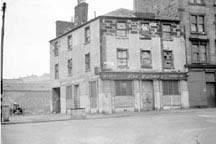
The Tavern 115 Finnieston Street corner of 272 Stobcross Street

The Tavern, corner of 115 Finnieston Street and 272 Stobcross Street.

This image was taken just before it was demolished in 1964.

There has been a pub on this site since 1858, when spirit dealer Matthew Quin acquired a licence for the premises. Matthew only lasted a few years in business and the pub seems to have closed for a few years.

In 1865 Charles Howard was licensee, again he only lasted a few years in business and by 1868 John F Muir was holding the licence. Mr Muir lived at 6 Finnieston Street and continued in the licensed trade here until 1880.

In 1881 Mrs S Loughran was the licence holder. Mrs Loughran lived at 55 London Street, Glasgow Cross before moving to 201 Dumbarton Road nearer to her place of business. She was also the licensee of a public house at 26 Elderslie Street (St Vincent Bar). Her husband Michael Loughran owned these pubs and his wife was licence holder.

When Mr Loughran died around 1898, John King became licensee and one of the trustees of his estate. John King was also licensee of the Plough Bar at 222 Stobcross Street.

In 1900 William John Loughran took over the running of the business and became the new licensee. William was probably Michael’s son. William continued as licensee until 1919. In 1920 Janie Mary Carr Loughran was now the licensee, she is probably William’s wife. Janie also owned the Plough in Stobcross Street.

From 1881 to the early 1950s the pub stayed in the Loughran family.

In 1953 Peter Calder was the licensee of this old pub followed by Mr Anthony Kennedy from 1955 to the early 1960s. The pub was demolished in 1964.
Filed Under: Finnieston Street, FinniestonStreet, T

The Rob Roy Spirit Vaults

March 22, 2017 by John Gorevan Leave a Comment


77 Finnieston Street, Glasgow.

In 1887 Samuel Blackstock had his small public house remodelled, which meant that 200 customers could now sit in comfort. The bar counter itself ran 26 feet long, beside this small rooms also known as snugs with high ceilings were set up. The pub like all the others were very busy especially when the Queen’s Docks was at the foot of the street.

Another landlord to run this pub was Robert Morrison, he took over in 1892 and made a good living from the pub, when he died his wife Louise took control of the business in 1915, the following year she sold up to James MacDonald.

There has been a public house on this site since 1853. James McBeath spirit merchant was the first to acquire the licence. However he only lasted a few years in this business until 1956.

In 1861 Duncan McVean was licensee he too only lasted a few years until 1863. In 1864 Mr Charles Scholefield traded here for less than a year before William Fleming took over. Again he lasted a few years too and sold up in 1868.

The next licensee was Joseph Rew, Joseph also owned a public house at 82 North Street and lived next door to that pub. He sold up in 1875.

John Colquhoun from 1875 to 1880. Hugh McNab from 1882 to 1885.

As above Samuel Blackstock owned the pub from 1887 until 1891.

Robert Morrison took over the pub from 1892 until the early 1900s. George Morrison was licensee in 1911.

James McDonald owned the pub from 1916 until the 1940s. One of the last publicans to run the pub was James Stirrat. The pub was demolished in the early part of 1960s.

License Holder. 1875 John Colquhoun.

Filed Under: Finnieston Street, FinniestonStreet, R

The Oriental Bar

March 15, 2017 by John Gorevan Leave a Comment

4 Finnieston Street, Glasgow.

Mr John Douglas. 1901.

The Oriental bar, 4 Finnieston Street was one of twelve public houses on this old street. The pubs on this street were full of sailor’s, mariner’s, engineer’s, labourer’s from all over the world.

In 1853 Robert McLellan was the first publican to run this public house. The following year James Paterson, wine & spirit merchant acquired the licence. James resided with his family at 3 Minerva Street, Glasgow.

Mr Robert McLellan served the locals here until 1865.

Alexander McGregor was the next spirit merchant to take over this pub. Mr McGregor made a good living from this pub. He lived with his wife and family firstly at 123 Kent Street in the east end of the city before moving to better accommodation at 50 St Vincent Street. Alex McGregor sold up in 1877.

The next spirit merchant to run this pub was James Smith from 1878 to 1890.

From 1891 to 1895 Henry Skinner was the holder of the licence before well-known wine and spirit merchant John Douglas took over.

Mr John Douglas was a member of the Tradeston Defence Association in the early part of 1900s. He also owned pubs at 46 Cook Street, 465 Cathcart Road. Mr Douglas stayed as licensee until 1910.

Mr John Douglas was born in Florence Street off Cumberland Street in the Gorbals area of the city. He was educated at the local school and then on to Hutcheson’s School under Mr Thomas Menzies, F.E.I.S.

After leaving school he worked in some minor situations, but this was not for John. He then entered the service of the well-known firm of Messrs Mowatt Bros., flour importers, as a traveller and cashier, a responsible position and arduous position, in which he wrought not only in Glasgow, but the whole of the West of Scotland.

John remained in this position for seven years. He then went on to work for Colonel Menzies of “Auld Scottie” famed whisky. He left this firm after four years. He was entertained by Colonel Menzies and his wife, giving him many gifts for his hard work.

He then left Glasgow to work in London to represent the well-known firm of Messrs John Walker & Sons, Ltd, distillers, whisky and wine merchants and brokers of Kilmarnock.

John Douglas then got married to Miss Skinner, daughter of Mr Henry Skinner, one of the best known and most respected members of the trade. After being in London for over two years, hearing that his father-in-law was very ill and anxious to retire from active business life, Mr Douglas was induced to resign his position in London, returned to Glasgow.

He then purchased a public house at 465 Cathcart Road and 4 Finnieston Street. A week after opening the business in Glasgow his father-in-law died.

John was a strict businessman and attended his premises every day. John also managed as trustee of the late Mr Skinner public house at 46 Cook Street, which licence was also carried on in his name.

Mr Douglas was nothing if not social. He was much sought after by the promoters of Smoking concerns and other social gatherings, where his genial presence, capital song, and other flowing goof humour made him a welcome guest and acquisition.

John was a zealous Mason of “Athole” Lodge, no. 413, an old Oddfellow of Lodge “Queen Victoria”, and a prominent member of the Bank Burns Club, a member of the Wine, Beer, and Spirit Trade Benevolent Association, a bowler with the Cathcart Bowling Club.

He was also a proficient swimmer, fond of pictures and a keen cultivator of flowers.

David F Gunn then took over the business, David ran a successful pub here until 1931. Mr Gunn survived the depression of the WW1 which was very hard work during war times. Many pubs closed sometimes for two days because of the shortage of beer.

Michael Foley another well-known Glasgow wine and spirit merchant took over in 1932. Michael also owned the Oriental Bar in Govan Road.

In 1937 Alexander Grant was the licensee, Alex was still running this pub until the early 1940s.

William Gallagher ran the Oriental Bar from 1945 until around 1967, the pub was then demolished.

—————————-

In The NEWS 1965…

2 Jailed After Pub Robbery.

Two men were each jailed for nine months at Glasgow Sheriff Court, when they admitted assaulting and robbing a publican and his barmaid of £11 16shillings.

They are Frederick Owens 25 of 17 Kelvinhaugh Street, Finnieston, and Bernard O’Hara, Finnieston, Glasgow. The Court was told that Owens and O’Hara went into the pub at 4 Finnieston Street on the night of January 26th and after one pint of beer, they were asked by publican William Gallagher to leave as he thought they had to much to drink.

They did, but minutes later dashed back, and while Owens ran behind the bar counter O’Hara seized the publican and barmaid. Owens grabbed a handful of notes and coins and both men ran out.

Later they were seen fighting in Argyle Street and arrested. They were later identified by Mr William Gallagher and the barmaid. An agent said the men had been celebrating a win at the dogs and had to much to drink. The incident was not planned, he said, it came over them on a spur of the moment. They were found guilty.


Licensees…

1967-1945 William Gallagher.

1945-1937 Alexander Grant.

1933 Michael Foley.

1919-1910 David F Gunn.

1910-1898 John Douglas.

1895-1891 Henry Skinner.

1890-1878 James Smith.

1877-68 Alexander McGregor.

1865-54 James Paterson.

1853 Robert McLellan.

Filed Under: Finnieston Street, FinniestonStreet, O

Dirty Dicks

January 8, 2017 by John Gorevan 2 Comments

175 Finnieston Street, Glasgow. G3 8HD. Demolished.

Image of Dirty Dicks bar 175 Finnieston Street dated 1938
Dirty Dicks. 1938.

Dirty Dick’s was a favourite haunt with sailor’s. To read more on the history of this once popular bar you will need to wait until Glasgow Pubs and Publicans Volume 2 comes out.

There has been a public house on this site since 1853, Thomas Welch ran a small public house on this site until 1860.

There were no records for anyone trading after this until 1865 when well-known and respected wine and spirit merchant J & R McIntyre acquired a licence to sell wine and spirits from these premises which was a new tenement with a public house on the ground floor.

Brothers John and Ronald traded under the title of J & R McIntyre and was trading from 1863 from premises at 179 Main Street, 35 Kelvinhaugh Street, and 43 Richard Street before taking over the new premises at 175 Finnieston Street.

Image of Dirty Dicks Bar 175 Finnieston Street dated 1948
Dirty Dicks. 1948.

The name of the pub then had J & R McIntyre above the door.

In 1870 John was living at 4 Gray Street just off Dumbarton Road while Ronald lived nearby at 9 Minerva Street. Ten years later the brothers had public houses at 50 Elderslie Street, 400 New City Road, 546 Dobbies Loan, 28 Burnside Street, 43 Richard Street, 49 Piccadilly Street, 35 Kelvinhaugh Street and stores at 16 Cranston Street.

In 1890 the brother were trading from 175 Finnieston Street, 179 Main Street, Cranstonhill, 50 Elderslie Street, 526 New City Road, 540 Dobbies Loan, 28 Burnside Street, 43 Richard Street, 49 Piccadilly Street and their offices still at 16 Cranston Street.

J & R McIntyre still traded after 1894 however the firm disposed on the Finnieston Street pub.

The next licensee was John H McLauchlin, John lived at 40 St Vincent Street and traded from Finnieston Street until the 1935.

From 1935 until the 1940s Patrick W McNulty was licensee, he also had a pub at 129 Oxford Street and resided at 87 Barnton Street, Carntyne, in Glasgow’s east end.

During the 1950s and 60s many will still remember James McLaughlan who owned the pub, he was the last licensee before the pub was demolished.

Image of Dirty Dicks bar 175 Finnieston Street dated 1955
Dirty Dicks. 1955.

Thanks to Glasgow Museums for this great image of Dirty Dicks which was taken by Partick Camera Club.

Facts…
Licensees…
1960-50 James McLaughlan.
1940 Patrick W McNulty.
1930-1894 John H McLauchlin.
1894-65 J & R McIntyre.
1960-53 Thomas Welch.
Also see Ship Inn Bar, Kelvinhaugh Street.

Do you remember this old pub? If so please leave a comment.

Filed Under: D, Finnieston Street, FinniestonStreet Tagged With: Dirty Dick's, Finnieston Street, Finnieston Street Pubs, J & R McIntyre, James McLaughlan, John H McLauchlin, John McIntyre, Patrick W McNulty, Pubs in the west end, Ronald McIntyre, Thomas Welch, West End

Artizan Vaults.

January 2, 2017 by John Gorevan Leave a Comment

3 Finnieston Street, Glasgow. Demolished.

Mr Robert C Kerr. 1897.

Wine and Spirit Merchant Robert C Kerr was born in Catrine, Ayrshire, Robert Burns country. Robert was educated at the village school. He started work very early in the cotton mills, cotton spinning being at that time one of the stable industries of Scotland.

Robert then went on to be a miner. What a change of occupation, from soft cotton to hard dark coal mining. Young Robert then can to Glasgow and worked in a large east end cotton factory. He then entered the spirit trade as an assistant in a pub owned by Mrs Armour, Stevenson Street, Calton.

Mr Kerr was very ambitious and mastered the trade, hoping to once own his own public houses. When the Anchor Tavern, 21 Argyle Street came on the market Robert jumped at the chance to be his own boss.

After acquiring the licence, business was good and seven years later opened the Artizan Vaults in Finnieston Street. Robert managed boss premises and was assisted by his son in the Anchor Bar. The Anchor Bar was located on the confines of the Trongate and in one of the busiest parts of Argyle Street.

Dick’s Bar, 3 Finnieston Street. 1966.

The history of the Anchor Bar dates back to 1788.

When Robert took over the Artizan Vaults in June 1895 the place was in great need of refurbishment. Robert installed incandescent light throughout the pub and the rooms were both comfortable and well ventilated. One neat little snuggery, known as the “Cosy Den”. A new gantry and spirit rack behind the bar was among the handsomest in the area, the walls were decorated with pictures and mirrors.

There was a large cellar underneath the premises from which beer was raised in cool and perfect condition by a Bruce beer engine. All the best whisky and liquor was stocked in the Artizan.

Robert became a licence holder in 1889, entered upon the Anchor on the 17th October 1889;m obtained the transfer on the 17th December; bought the “Artizan” on 17th June, 1895; and obtained the transfer 17th April, 1896. Seven is surely his lucky number.

Dick’s Bar. 3 Finnieston Street.

The history of the Artizan can be traced back to 1867 when Wine and Spirit Merchant James Taylor acquired a certificate to sell wines and spirits at 3 Finnieston Street. James was born in Rutherglen.

By 1880 James was living with his family at 5 Finnieston Street and purchased another public house The Royal Bar, 328 Scotland Street at the corner of Watt Street. Five years later we find his residing at 115 Dumbarton Road before moving to 16 Strone Terrace, Dowanhill, so business was very good.

In 1881 James was living with his wife Janet Colquhoun with seven daughters and one son.

When Mr James Taylor passed away in the early part of 1890s his wife took over the business until 1895.

Robert C Kerr then took over the pub. Robert was living at 91 North Hanover Street in the city centre. He gave up the Artizan Vaults in 1898.

David Burrell then took over the pub and continued to serve the locals until 1908.

Another well-known and respected Glasgow Publican to own the pub was James McCondach, who ran the pub until the 1950s. Many will still remember Raphael Issacs in the 1960s before Mr John Dick took over the pub and renamed it Dicks Bar.

In the 1950s this old pub was known as the Cosy Corner. Maybe someone was renovating the old bar and saw a sign the “Cosy Den” in the snug bar and renamed the pub the Cosy Corner.

Do you know anything about this pub? If so please leave a comment.

END.

Filed Under: A, Finnieston Street, FinniestonStreet Tagged With: Artizan Vaults, Finnieston Street, Finnieston Street Pubs, Pubs on Finnieston Street, Robert C Kerr

Columba Bar

January 2, 2017 by John Gorevan Leave a Comment

41 Finnieston Street, Glasgow. G3 8HB. Demolished.

Finnieston Street has always been well provided for in terms of drinking places, with all the sailors, mariners, boatmen, engineers from the quays nearby. The tills in all the pubs in Finnieston Street, Anderston Quay, Lancefield Quay and Broomielaw were filled with foreign currency as the customers came from all corners of the world.

The first licensee to own this pub was John Lawrence who obtained a certificate in April 1873. John was born in England in 1827. He met his wife and had a family in England before coming to Glasgow to set up business as a publican. In 1881 John was residing at 43 Finnieston Street with his wife Prudence, son William who was a butcher to trade and son John who assistance his father in the licensed trade.

John continued business here until 1907. In October 1908 the licence was taken over by Archibald Jackson. Mr Jackson refurbished the premises and putting his own decor into the pub and renamed the pub Jackson’s Bar.

Archibald Jackson made a good living out of the licensed trade. In 1921 he was living at 38 Randolph Gardens before moving to 58 Balshagray Avenue in 1941. Archibald’s also owned a public house at 82-84 Castlebank Street, Partick.

In 1919 Margaret Ann Swan Jackson was licensee of the pub on Castlebank Street. She was paying an annual rent of £65 for the pub.

During the 1960s the pub was licensed to Florence Mary McBride Jackson Griffins, she was also licensee of the Castlebank Street premises.

Throughout the pubs history only two different families owned it.

The pub was demolished in the mid 1960s.

Do you remember this old Pub? If so please leave a comment.

Filed Under: C, Finnieston Street, FinniestonStreet Tagged With: Archibald Jackson, Columba Bar, Finnieston Street, Finnieston Street Pubs, Florence Griffins, John Lawrence, Margaret Jackson

  • Page 1
  • Page 2
  • Go to Next Page »

Primary Sidebar

Become a Member of Old Glasgow Pubs

We are very excited to announce that we have created a new membership! In return for supporting the site, you will gain fantastic perks! Click below to find out how you can support the site!

💖 Donate via PayPal

All content on this site is Copyright Old Glasgow Pubs (OGP). To use any history or images, please make sure you link back to our site.

This website uses cookies to improve your experience. We'll assume you're ok with this, but you can opt-out if you wish. Cookie settingsACCEPT
Privacy & Cookies Policy

Privacy Overview

This website uses cookies to improve your experience while you navigate through the website. Out of these cookies, the cookies that are categorized as necessary are stored on your browser as they are essential for the working of basic functionalities of the website. We also use third-party cookies that help us analyze and understand how you use this website. These cookies will be stored in your browser only with your consent. You also have the option to opt-out of these cookies. But opting out of some of these cookies may have an effect on your browsing experience.
Necessary
Always Enabled
Necessary cookies are absolutely essential for the website to function properly. This category only includes cookies that ensures basic functionalities and security features of the website. These cookies do not store any personal information.
Non-necessary
Any cookies that may not be particularly necessary for the website to function and is used specifically to collect user personal data via analytics, ads, other embedded contents are termed as non-necessary cookies. It is mandatory to procure user consent prior to running these cookies on your website.
SAVE & ACCEPT