• Skip to primary navigation
  • Skip to main content
  • Skip to primary sidebar
Old Glasgow Pubs

Old Glasgow Pubs

  • Home
  • About Us
  • Find A Pub
  • Find Address
  • Find A Publican
  • Further Reading
  • Shop
  • Contact Us
  • Members Area
  •  
  • Click Here to Search the Site
You are here: Home / Latest Posts

Latest Posts

The Nairn

January 2, 2017 by John Gorevan Leave a Comment

Woodhill Road, Bishopbriggs, Glasgow. G64 1JL. Tel: 0141 762 2262.
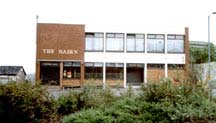
Nairns

Nairn’s. 1991.

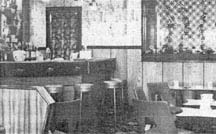
Opened in 1965 The Nairn was built to cater for weddings and functions in the area. It was equipped with three bars a function room and a large kitchen. Scandinavian decor was a feature of the lounge bar, a wall separated it from a small cocktail bar in broken wrought iron work with artificial climbing plants.

The ceiling of the cocktail bar was railed into sections by narrow black oak beams, the walls were panelled in elm intersected with ebony strip wood. The bar front was of elm wood with a black speckled bar counter.

The walls were decorated with prints of vintage cars, the light fittings suspended from the ceiling were replicas of old oil lamps. On the upper floor was the function room with a brides room for weddings.

There was also a small stage at the end of the room. Adjacent to this was the large kitchen. Another feature of the Nairn was the stereophonic music system which was wired throughout the whole building.

The Nairn was owned by the West of Scotland Taverns part of J & R Tennent group and managed by John Middleton.
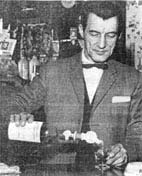
John Middelton manager of the Nairn

Manager of The Nairn, John Middelton. 1965.
Nairn interior1

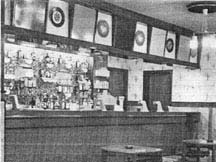
Interior view of the new bar. 1965.

Nairn interior2

Interior view of the cocktail bar. 1965.

Now Called The Campsie. Tel: as above.
Filed Under: N, Woodhill Road, WoodhillRoad

Camphill Spirit Vaults.

January 2, 2017 by John Gorevan 1 Comment

2 Main Street, Bothwell, Glasgow. G71 8RD. Tel: 01698 850 888.

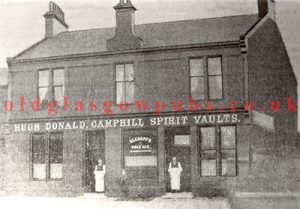
Image of the Camphill Spirit Vaults dated 1897
The Camphill Spirit Vaults. 1897.

Mr Hugh Donald was trading from here since 1891. It was first licensed in 1848 as a wayside hostelry, it has always been a favourite resort for wayfarers and residents alike. When Mr Hugh Donald took over in 1891 he gutted the place and made alterations and improvements to take it to modern time. Hugh owned the premises and lived upstairs in one of the apartments.  In 1891 the new interior was eye catching, the first to attract the eye was the beautiful spirit rack, with its fine carved work and many coloured crystals.

The old counter had been removed and a massive semi-circular one occupied its place. Beer pumps, cork drawers, and other modern fixtures and fittings have been added, while an ingenious arrangement for supplying hot and cold water continuously is fitted up behind the bar. The ceiling is lofty, and this, along with the walls, has been covered with anaglyptic paper, varnished of beautiful design. Taken as a whole, the bar is fitted up in a manner that would do credit to any capital towns, and at night, when the installation of incandescent light is in operation, the interior has an effective and almost dazzling appearance.

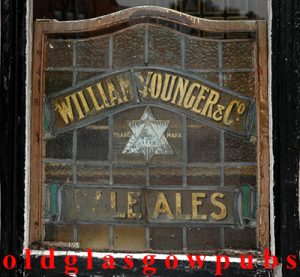
Image of one of the leaded advertising windows of the Camphill Vaults. 2005
One of the advertising windows in the Camphill Vaults. 2005.

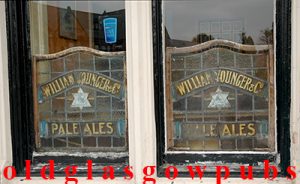
One of two windows advertising William Younger & Co. Pale Ales.

In addition to the parlour, stock-rooms, and Lavatory there are three commodious and well appointed sitting rooms, lofty and well lighted completely upholstered, and fitted with electric bells and a beautiful fireplaces. The floors were laid with linoleum and the walls tastefully hung with pictures and engravings. While the wines, special liqueurs, and bottled and bottled ales and stouts are mostly kept in the stock rooms, there is a splendid cool cellar underneath the premises from which the draught liquors are raised to the counter in perfect condition, the walls are dry and the floor is of concrete.

Image of one of the advertising windows 2005
Another view of the advertising windows. 2005.

Mr Donald buys only from firms of guaranteed reputation, and among these names as Bass, Guinness, Raeburn, McEwan, Henry Thomson and McIntyre (“Era” blend) and Mr Donald’s own blend of Camphill Scotch whisky. A separate entrance has been provided for the family department (Off Sales) which has proved a success since Hugh opened it to the public.

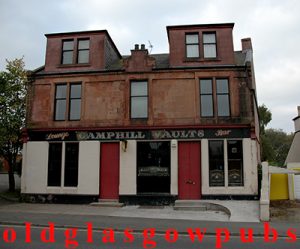
Image of the Camphill Vaults. 2006
The Camphill Vaults. 2006

Note the addition of two rooms in the attic.

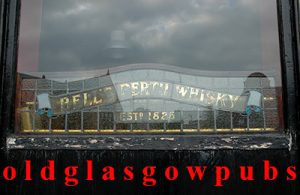
Image of and advertising window 2005

This stained glass window is advertising Bell’s Perth Whisky with an established date of 1825.

The accepted practice in the 1830’s was to use young, immature whiskies for blending. Arthur Bell, however, was adamant that only mature whiskies be used in the blend of Bells Whisky, a decision that earned him a reputation not only as a specialist blender, but as a man of vision with the highest regard for quality.

In the early days Bell refused to put his name on a blend, believing that the quality should speak for itself.

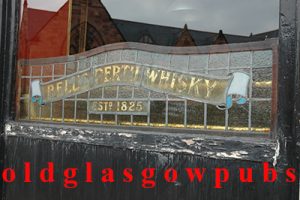
Image of another advertising window for Bells Perth Whisky 2005
Another advertising window for Bells Perth Whisky. 2005.

After his sons joined the company, they convinced him that branding their product could only be good for business and in 1904 the first label appeared bearing the words “Arthur Bell & Sons Extra Special Old Scotch Whisky, Perth, Established 1825.”

It was only in 1925 that “Afore ye go” was registered as the official company slogan for Bells Whisky.

It’s story is as follows: During the First World War, the Bell family would have a few cases of Bell’s Extra Special Old Scotch Whisky sent down to the docks to be distributed among the troops going off to the Western Front. The idea being that they should have a wee dram, …”afore ye go”.

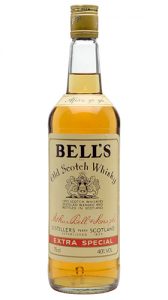
Image of a bottle of Bell's Scotch Whisky
Bell’s Special Scotch Whisky.

Do you have any memories of this old Public House? If so please leave a comment.

END.

Filed Under: Bothwell Tagged With: Camphill Spirit Vaults, Camphill Vaults, Hugh Donald, Main Street Bothwell, Old stained glass windows advertising Bell's Perth Whisky, Old stained glass windows advertising William Younger & Co Pale Ales

Camperdown Bar.

January 2, 2017 by John Gorevan 1 Comment

529 Garscube Road corner of 2 Camperdown Street, Glasgow. G20 7LD. Demolished.

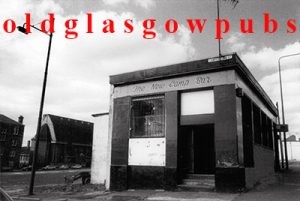
The New Camp Bar. 1970s.

There has been a public house on this spot since the 1860s. One of the first names this pub had was the Oakbank Spirit Vaults, the pub was situated next to the Oakbank School at the corner of Barr Street intersects as it was then known.

Mr H Robertson was proprietor in 1863 and traded at number 343 Garscube Road, the numbering of the street changed through time. By the 1870s wine and spirit merchant John Peacock was landlord and served the locals until 1901. Mr Peacock was a good businessman he also owned pubs at 64 North Woodside Road corner of 64 Lyon Street and the Old Basin Vaults, 58 Old Basin which he took over in 1886. John Peacock owned the premises on Garscube Road and sold up in 1901.

Another prominent figure in the Scottish Licensed Trade John Higgie then took over the pub. Mr Higgie lived at 6 Doune Gardens before moving to 2 Oxford Drive in Kelvinside in 1903. John Higgie was also a traveller for the Greenhead Brewery and in 1909 became one of the directors of Steel, Coulson. Ltd., the other director was Simon Cameron. Mr Higgie ran the Oakbank Spirit Vaults until the end of the First World War.

In the 1930s Archibald Hay was running the pub with the help of his wife, Archibald died in 1933, his wife then took over the running of the business and continued as licensee until the 1960s.

Many will remember this old pub as the Camperdown Bar and the New Camp Bar which was run by Murdoch MacKenzie until the pub was demolished in the that 70s.

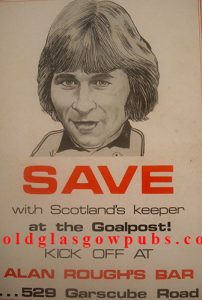
Alan Rough famed Scottish Goalkeeper owned this pub for a while and renamed it the Goal Post Bar.

Alan Rough’s Bar, the Goal Post Advert.

Alan Rough got his training in a well-known city centre pub.

In the NEWS 1979…

If ALAN drops a clanger…

It might have been a nightmare at Hampden last night for Scotland goalkeeper Alan Rough, but brother Dough showed today that at least the family are keeping their sense of humour.

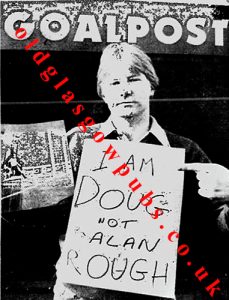
Dough is the look-alike relative who runs Alan’s pub in Maryhill and he is getting just a bit fed up with fans coming in and asking for his autograph. So he decided to make it clear that he is his own man, and not the player who one his record equalling 28th cap for Scotland against Austria.

Scotland, if you haven’t heard by now, dropped a vital point in the European Championship match they really had to win to give them a real chance of qualifying for the finals in Rome, and it was a goal keeping blunder by Rough which cost Scotland a point.

BRAVE

And to make Alan’s night worse, he chose to turn up at his pub last night just as the match came up on Television. Said brother Dough, pictured above as he looked at a shot of the Hans Krankl goal which followed Alan’s boob, “It certainly was an unfortunate time to come in for him.

“He had to take a lot of stick from the regulars when they saw the Austrian goal. I felt sorry for him, but he has been brave and honest enough to admit the blame. What more can he do?”

Dough, however, has no sympathy for the twist of nature which made him a dead ringer for the Partick Thistle man who is only one match away from becoming Scotland’s most capped keeper.

“It has been going on for ages,” he said. “And I must say it does get boring after a while. People keep asking me for my autograph when they come into the pub for the first time.

“But I suppose I will have to put up with it.”

Do you remember this pub. If so please leave a COMMENT.

END.

Filed Under: C, Garscube Road, GarscubeRoad Tagged With: Alan Rough, Camperdown Bar, Camperdown Street, Dough Rough, Garscube Road, New Camp Bar, Oak Bank Spirit Vaults

MacSorley’s

January 2, 2017 by John Gorevan 1 Comment

42 Jamaica Street, Glasgow. G1 4QG. Tel: 0141 248 7629

3.5 Star rating

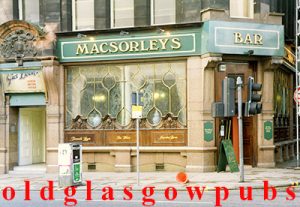
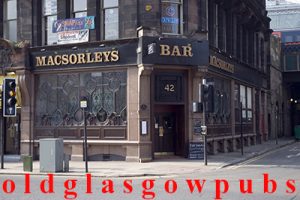
image of MacSorley's Bar 42 Jamaica Street, Glasgow
MacSorley’s Bar. 1991

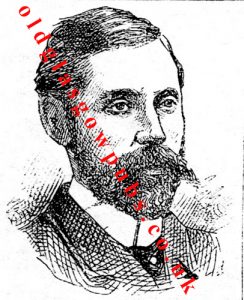
There has been licensed premises here since 1861 owned by William Dryburgh. In 1889 George McGregor took over the running of this popular pub.

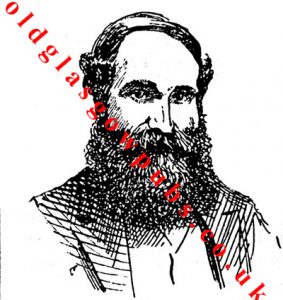
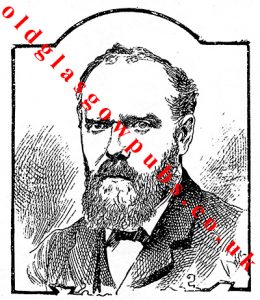
Etch of Mr George McGregor 1889
Mr George McGregor. 1889

George McGregor hailed from Perthshire he also owned the Clan Vaults. He blended his own whisky on the premises. The traveller could stay in one of the ten well ventilated rooms available. McGregor continued as licensee until 1890.

The next licensee for the old Clan Vaults, 44 Jamaica Street was Gray Edmiston as well known property owner and businessman in Glasgow. Mr Edmiston owned several well known bars in the city including the Lyceum Vaults, 145 Trongate and the Camel’s Head Vaults at the Royal Theatre, Cowcaddens.

In 1887 Mr Edmiston was at the Licensing Courts, trading at 87 Cowcaddens, (Camels Head,) he sought to open his old entrance to the back bar and restaurant, but was refused. Mr Edmiston explained to their honours, some of whom visited the premises, that formerly there were three entrances for the front and back bars, that on the latter he expended some £300 to meet the requirements of a rising business, and satisfy the views of the authorities. When a man fits up the premises at great outlay, lavatories, open fires, comfortable sedans and all the other luxuries.

drawing of Gray Edmiston. 1887
Gray Edmiston. 1887

The old Clan Vaults was entered from Jamaica Street by a very elegant tiled entrance, under the sign of the Golden Grapes, there was a snuggery on either hand, while in front was a screen to shield those at the bar from the vulgar gaze of the passers-by, on whose painted glass panels was inscribed the words, “Clan Vaults,” and pictures of the Camel’s Head (Mr Edmiston’s trade mark,) which, with design in flowers, fruits &c., formed a very striking feature of the pub. In front of you was not a horse shoe, but a half moon bar fitted with all the most recent modern aids to those in charge, in the way of cork-drawers, pumps, &c.&c. The bar proper, that is, behind those behind the counter, contains barrels of a quaint design with silver hoops, forming, with the bottles and coloured glasses, an effective background.

The premises were entirely repainted in 1891, outside and in, and the handsome Japanese paper on the walls gave an air of richness, warmth and comfort. Passing in, on the right hand is the gentlemen’s lavatory, light, airy and roomy. While in a sheltered nook a dram and social crack can be had openly at a little round table in the Continental style.

Midway in the passage, between the ordinary and first class bars, is the ladies room, specially fitted up for their convenience, an important desideratum too often over-looked. On the opposite side is a large, well-appointed room, called No.2, but pass on, and into, the first-class bar, only stopping to admire the Ann Street entrance. Entering no5 Ann Street, the Clan Vaults was engraved on a marble floor as you go in. This bar like the front bar was a half moon shape, and was one of the most elegantly appointed in the city. The counter was overtopped with white marble, while the walls were enlivened by elegant, mahogany cased plain mirrors. Merely glancing at the handsome plush upholstered furniture also of mahogany, and remarking the fireplace with its painted tiles. Civil young ladies were employed as waitresses. Gray Edmiston sold the pub to Philip MacSorley in 1897.

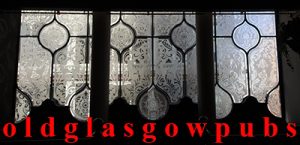
three etched glass windows of MacSorley's Bar 2005
Three etched glass windows of MacSorley’s Bar. 2007

Still known as the Clan Vaults, Philip MacSorley took over the old premises in 1897, he commissioned architects Clarke & Bell and R A Bryden to built a new tenement with a pub on the ground floor on the site of the old pub. The new building was completed in 6 February 1899.

MacSorley’s new bar opened in 1899, situated at the corner of Jamaica Street and Ann Street. The interior had a large mahogany oval shaped bar counter with neat little recesses which could hold parties of five or six. At the further end a smaller snack bar and oyster counter had been fitted. Electric lights were installed and a new heating system fitted, the massive cellar was now underground with an extensive kitchen and the new toilets were the most up-to-date in town.

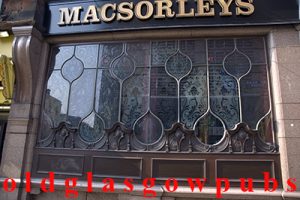
MacSorley's windows taken from Jamaica Street 2009
One of the large windows in MacSorley’s. 2008

In 1904 MacSorley’s had a reputation of being the quickest service restaurant in the city. A dining room and grand smoking room was soon added with a room for the ladies as well as an American cocktail bar. All the best drinks were served here including Champagne and MacSorley’s special blend of Peacemaker whisky. MacSorley owned other city pubs including Maitland Street, Garngad, the Hampden Vaults, Crossmyloof, Holland Street and Dumbarton Road.

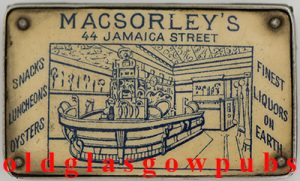
image of MacSorley's Vesta matchbox very old
MacSorley’s tin Vesta case (tin matchbox) this box is over one hundred years old. Bought from Ebay in 2015.

Malcolm McIntyre took over after MacSorley in 1910. Mr McIntyre and his father came to Glasgow from Stornoway, where they had carried on a very successful hotel business. On arriving in Glasgow they soon purchased Lauder’s Bar, Sauchiehall Street and MacSorley’s, Jamaica Street together with another pub at Anderston Cross with Archibald Lauder’s wholesale business in West George Street.

In 1920 they disposed of the retail business while retaining the wholesale department of Lauder’s famous “Royal Northern Cream.”

Malcolm’s sister ran the Royal Station Hotel, Forres, his entire family seemed to be involved with the licensed trade at some time in their lives.

Malcolm died in 1932 after a long visit to Canada where he had important interests. Shortly after his arrival in Glasgow he was taken ill and died as a result.

image of  exterior MacSorley's Bar date 2008
MacSorley’s Bar. 2008.
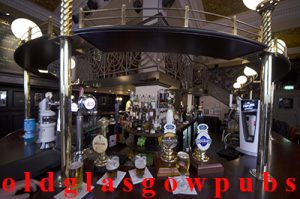
image of MacSorley's Bar date 2008
Interior view of the main bar. 2013.
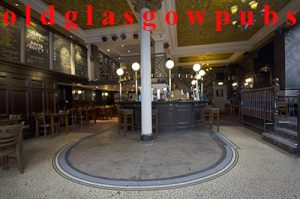
image of the interior of MacSorley's Bar showing an old tiled floor
Old tiled floor in the main bar. 2009.

The old tiled floor was discovered in 209 after alterations. The floor covering was pulled up and revealed this very old tiled floor. After hard work of trying to clean the tiles up this magic floor look great.

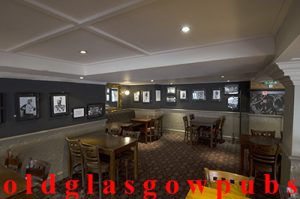
image of upstairs area with seats and tables  image taken 2013
The eating area upstairs. 2013.

Great food is always served at MacSorley’s Bar. After eating up here you have a great view of the area below.

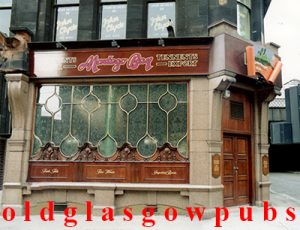
image of Montego Bay 1980s formerly MacSorley's Bar
Montego Bay. 1980s

During the 1980s the pub was known as Montego Bay.

I received an email from MacSorley’s Bar on 9 December 2009, the pub has been refurbished and opened again which I’m sure will be a great success as a music venue. On refurbishment the old floor was lifted and the mosaic tiled floor which had been underneath the floorboards for many years.

Good Luck in your new venture. CHEERS.

Update 12/12/2013…

Michael Smith is the owner of one of Glasgow’s best known live music bars MacSorley’s.

Good Luck to Mr Michael Smith.

If you are one of the few people who have never been in MacSorley’s Bar then you are missing out in one of the best live music bars in town. Great Music, live entertainment, and very reasonable prices.

Update January 2016…

One of Glasgow’s most iconic pubs is set to close next month. MacSorley’s on Jamaica Street has been a local favourite for music lovers for over 100 years!

A statement from the manger confirmed the grim news “We are sad to announce the closing of the doors, fittingly on Sunday 14th February. In the spirit of THE LAST WALTZ the weekend will feature all the usual suspects as well as some very special guests. Please join us and show some love as we say goodbye.”

Hopefully someone will take over this premises as a pub and keep the great history alive.

Update September 2016…

I received an email from JB that MacSorley’s opened at the end of June 2016: Hi John
Enjoyed your info on Macsorleys on Jamaica street.
The pub re-opened at the end of June 2016,
I’m not to clued up by whom but…
There’s live music on a Thursday, Friday, Saturday & Sunday.
Including 3 acts on Saturday & Sunday.
Jazz on Saturday afternoon – was a trio followed by a big band this Saturday, then s rock band in the evening.
Sunday is tribute day, two acts in the afternoon then one in the evening.
Full info available on facebook “macsorleys 2016”
J.B.

We at Old Glasgow Pubs will give MacSorley’s a surprise review soon.

If you have anything you would like to add just email me at [email protected]

Click here to read review for this pub

Facts…

Philip MacSorley had his own blend of whisky called “Peacemaker.”

In 1878 Philip MacSorley was a traveller for (A D McDougall) wine merchant, 104 West Campbell Street.

In 1886 Philip MacSorley was a commercial traveller for (Taylor & Ferguson) wholesale wine and spirit merchants, 38 Oswald Street, goods entrance 37-45 Ann Street, this was very near to where he built MacSorley’s Bar. Philip’s address was 7 Regent Park Terrace, Strathbungo.

In 1899 MacSorley had public houses at 72 Maitland Street, 131 Garngad Road, 1 Spring Place, Crossmyloof, 1147 Pollokshaws Road, 44 Jamaica Street,and 148 Holland Street and was living at 10 Queen Margaret Crescent.

In 1925 Philip MacSorley, Spirit Agent at offices, 93 Hope Street, he was living at Buckingham Street.

Kenneth MacLennan was manager of MacSorley’s Bar, Jamaica Street prior to 1914 and possibly after the first world war war, he was originally from Avoch on the Black Isle.

Licence Holders.
1991 Joyce Getty for Tennents.
1970 Robert Purvis Green.
1970-1950 J Thomson.
1949-1920 Neil Gillies.
1919-1910 Malcolm McIntyre.
1909-1897 Philip MacSorley.
1895-1891 Gray Edmiston.
1890 Mrs George McGregor.
1889-1878 George McGregor.
1877-1861 William Dryburgh.

Do you have any memories of MacSorley’s? If so please leave a comment.

Filed Under: Jamaica Street, JamaicaStreet, M Tagged With: City Centre, Clan Vaults, George McGregor, Gray Edmiston, J Thomson, Jamaica Street, Joyce Getty, Kenneth MacLennan, MacSorley's Bar, Malcolm McIntyre, Montego Bay, Neil Gillies, Peacemaker whisky, Philip MacSorley, Robert Purvis Green, Tennents Caledonian Breweries

The Camden Bar.

January 2, 2017 by John Gorevan 2 Comments

103 Caledonia Road, corner of 68 Camden Street, Glasgow. G5. Demolished.

image of Alexander McLaren
Mr Alexander McLaren. 1893

The Camden Bar was situated at the corner of 103 Caledonia Road and 68 Camden Street. In 1893 Alexander McLaren was the proprietor and completely refurbished the premises. Mr McLaren was a native of Balquhidder, Perthshire, where he was educated. He left his birth place and came to Glasgow at the age of twenty three, and at once set to work, first of all as a porter in a stationer’s warehouse, but only remained there for six months. It was in 1871 that he joined the licensed trade, of which he remained as a distinguished member.

For six years he managed Mr William Fraser’s business at the foot of Pollok Street, but being ambitious, he resolved to strike out on his own account, and bought the well-known business at 146 Stirling Road. Later he acquired another pub, on Duke Street, but disposed of it in 1890. Mr McLaren was an active member of the Wine, Spirit and Beer Defence Association, an ardent Freemason (St. John’s,) and altogether a most popular gentleman.

Daniel Douglas was the first licence holder and acquired a certificate in 1866. Mr Douglas lived nearby at 22 Caledonia Road before moving to 214 Crown Street. In 1870 he was running pubs at 196 Rose Street, and 124 Garngad Road.

Four years later he acquired another pub at 110 Rutherglen Road. He was now living in better accommodation at Roslyn Terrace, Pollokshields. Daniel continued to serve the locals at Caledonia Road until 1892.

The licence was then taken over by popular wine and spirit merchant Alexander McLaren. He also had a pub at 146 Stirling Road. He resided at 296 Crown Street with his wife and family. The McLaren family continued to run this pub until the 1950s.

When Alexander passed away his wife Matilda took over the running of the business. She was also running a pub at 137 Cathedral Street.

Do you remember any of the old pubs in the Gorbals? If so please leave a comment.

Are you a relative of Alexander McLaren? If so please leave a comment.

END.

Filed Under: C, Camden Street, CamdenStreet Tagged With: Alexander McLaren, Caledonia Road, Camden Street, Gorbals, pubs in Gorbals, The Camden Bar

Caley Bar.

January 2, 2017 by John Gorevan Leave a Comment

47 Caledonia Road corner of 370 Crown Street, Glasgow. G5. Demolished.

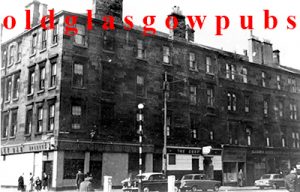
The Caley Bar, image taken from Caledonia Road looking up Crown Street. Thanks to Norrie McNamee.

There has been a public house on this site since 1859. The first licensee was spirit merchant Robert McCormick. He lived with his wife and family at nearby 287 Crown Street. Mr McCormick traded from here until 1872.

The next licensee was George Duncan, a wine & spirit merchant from Caledonia Road (Caley Road). 1873 to 1889.

George Fisher was next on the list of licensees 1889 to 1891.

Over the years many spirit dealers have come and gone including James Dunn 1892-1904, James paid an annul rent of £80.

William Hunter from 1905 to 1927.

William Davidson from 1927 to 1933.

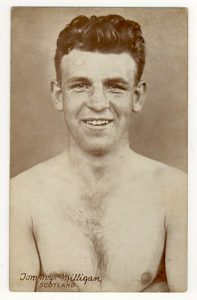
And one of the most famous publicans was Thomas (Tommy) Milligan. Tommy Milligan was not just a great publican he was also a Champion Boxer. Tommy Milligan b02/03/1904 d17/12/1970, was born in Shieldmuir, Wishaw. He was the Scottish Professional Welter/middleweight boxer of the 1920s, who won the Scottish Area welterweight title, the British Empire welterweight title, European boxing British middleweight title.

Many of his fans frequented the pub which was known by the locals as Milligan’s Bar.

Young Thomas (Tommy) Milligan.

Tommy opened another pub at 236 Dalmarnock Road, The Gushet House at the corner of 123 Old Dalmarnock Road.

The Gushet House, corner of Dalmarnock and Old Dalmarnock Road. Thanks to Gordon Adams for the image.

After Tommy Milligan, James G Angus took over on behalf of the West of Scotland Taverns Ltd. He was also licensee of pubs at 382 Argyle Street (the Kendal), 641 London Road (the Station Bar) and 980 London Road (the Wee Ship).

In 1969 George Laird was licensee on behalf of Tennent Caledonian Breweries Ltd.

Do you remember this old east end local? If so please leave a comment.

END.

Filed Under: C, Caledonia Road, CaledoniaRoad Tagged With: Boxer Tommy Milligan, Caledonia Road, Caley Bar, Crown Street, Gorbals, Gushet House, Old Dalmarnock Road, Robert McCormick, Tennent Caledonian Breweries, Thomas Milligan, West of Scotland Taverns

  • « Go to Previous Page
  • Page 1
  • Interim pages omitted …
  • Page 380
  • Page 381
  • Page 382
  • Page 383
  • Page 384
  • Interim pages omitted …
  • Page 437
  • Go to Next Page »

Primary Sidebar

Become a Member of Old Glasgow Pubs

We are very excited to announce that we have created a new membership! In return for supporting the site, you will gain fantastic perks! Click below to find out how you can support the site!

💖 Donate via PayPal

All content on this site is Copyright Old Glasgow Pubs (OGP). To use any history or images, please make sure you link back to our site.

This website uses cookies to improve your experience. We'll assume you're ok with this, but you can opt-out if you wish. Cookie settingsACCEPT
Privacy & Cookies Policy

Privacy Overview

This website uses cookies to improve your experience while you navigate through the website. Out of these cookies, the cookies that are categorized as necessary are stored on your browser as they are essential for the working of basic functionalities of the website. We also use third-party cookies that help us analyze and understand how you use this website. These cookies will be stored in your browser only with your consent. You also have the option to opt-out of these cookies. But opting out of some of these cookies may have an effect on your browsing experience.
Necessary
Always Enabled
Necessary cookies are absolutely essential for the website to function properly. This category only includes cookies that ensures basic functionalities and security features of the website. These cookies do not store any personal information.
Non-necessary
Any cookies that may not be particularly necessary for the website to function and is used specifically to collect user personal data via analytics, ads, other embedded contents are termed as non-necessary cookies. It is mandatory to procure user consent prior to running these cookies on your website.
SAVE & ACCEPT